
Traveling is the correct spelling for most everyday writing in the US, while travelling is used elsewhere. Both words mean the same thing — the only difference is the number of Ls.
If you’re writing for a US audience, stick with traveling.
Traveling vs. Travelling
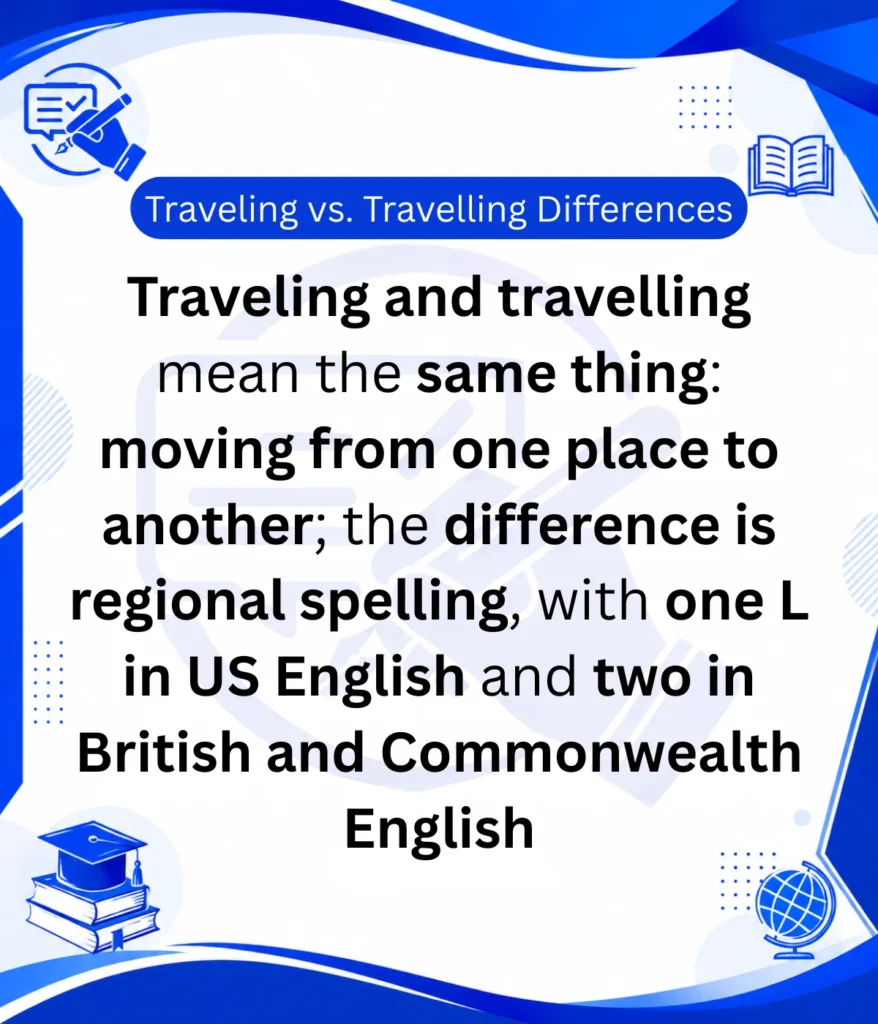
The two spellings — traveling and travelling — come from the same root word: travel. Neither one is “wrong.” They’re simply regional variations that developed over time.
The difference comes down to one letter: a single L or a double L. This small change affects how the word looks in writing, but the meaning never changes.
Traveling (Single L)
Traveling uses just one L. This is the standard spelling you’ll see in newspapers, business documents, and everyday writing across the US.
Travelling (Double L)
Travelling uses two Ls. This version is common outside the US and shows up often in international publications and global travel sites.
More Posts:Proved vs. Proven – Meaning, Differences & Usage
Which Spelling Should You Use?
If your readers are based in the US, use traveling. This applies to blogs, emails, resumes, marketing copy, and school assignments.
Style guides like AP Style and Chicago Manual of Style both confirm traveling as the standard choice. Sticking to one spelling also keeps your writing consistent and easy to follow.
Why Do the Spellings Differ?
The spelling split traces back to language reform in the early 1800s. A lexicographer named Noah Webster wanted to simplify English spelling to make it more efficient and easier to teach.
Webster dropped extra letters from many words — think color instead of colour, or honor instead of honour. Traveling followed the same pattern.
Outside the US, the older spelling with two Ls stuck around. That’s why travelling remained the standard in many other English-speaking regions.
The Double “L” Spelling Rule
When to Double the Letter
If the stress falls on the last syllable of a word, double the final consonant before adding a suffix. For example, admit becomes admitting, and regret becomes regretting.
When Not to Double the Letter
If the stress falls on the first syllable, skip the doubling. Since travel stresses the first syllable, it becomes traveling — with just one L.
| Word | Stress | Result |
|---|---|---|
| admit | Final syllable | admitting |
| begin | Final syllable | beginning |
| travel | First syllable | traveling |
| open | First syllable | opening |
Traveler or Traveller? Traveled or Travelled?
The single-L vs. double-L pattern doesn’t stop at traveling. It carries over to related words too.
Traveler or Traveller
Traveler uses one L and is the standard spelling in the US. Traveller, with two Ls, is common elsewhere.
Traveled or Travelled
The same rule applies here. Traveled is the version you’ll want for US writing, while travelled appears in other regions.
Here’s a simple breakdown of all four word forms:
- Traveling — one L, standard in the US
- Travelling — two Ls, used elsewhere
- Traveler — one L, standard in the US
- Traveller — two Ls, used elsewhere
Keeping these forms consistent throughout your writing makes it look polished and professional.
More Posts:Spelled or Spelt – Meaning, Differences & Usage
Traveling or Travelling FAQs
Is it “traveling” or “travelling” in the US?
Traveling, with one L, is standard in the US. Travelling is the version used in British and Commonwealth English.
Why does traveling have one L instead of two?
Noah Webster simplified many English spellings in the 1800s, dropping extra letters to make words shorter and easier to teach.
What is the double L spelling rule?
Double the final letter only when the stress falls on the last syllable of the word, like in admit → admitting.
Is “traveler” or “traveller” correct?
Traveler, with one L, matches the standard spelling pattern used alongside traveling and traveled.
Can I use “travelling” in everyday writing?
Yes, it’s not incorrect — just keep your spelling consistent and match it to your intended audience.
Final Thoughts
Both traveling and travelling are correct — they just serve different audiences. For US-based writing, traveling, traveler, and traveled are your safest, most consistent choices. Pick one style and stick with it throughout your writing.

Hi, I’m John Henry, the voice behind Grammar Nudge. I make grammar simple and easy to understand, from basic rules to advanced writing tips. Clear explanations. Practical examples. No confusion.
Related Posts