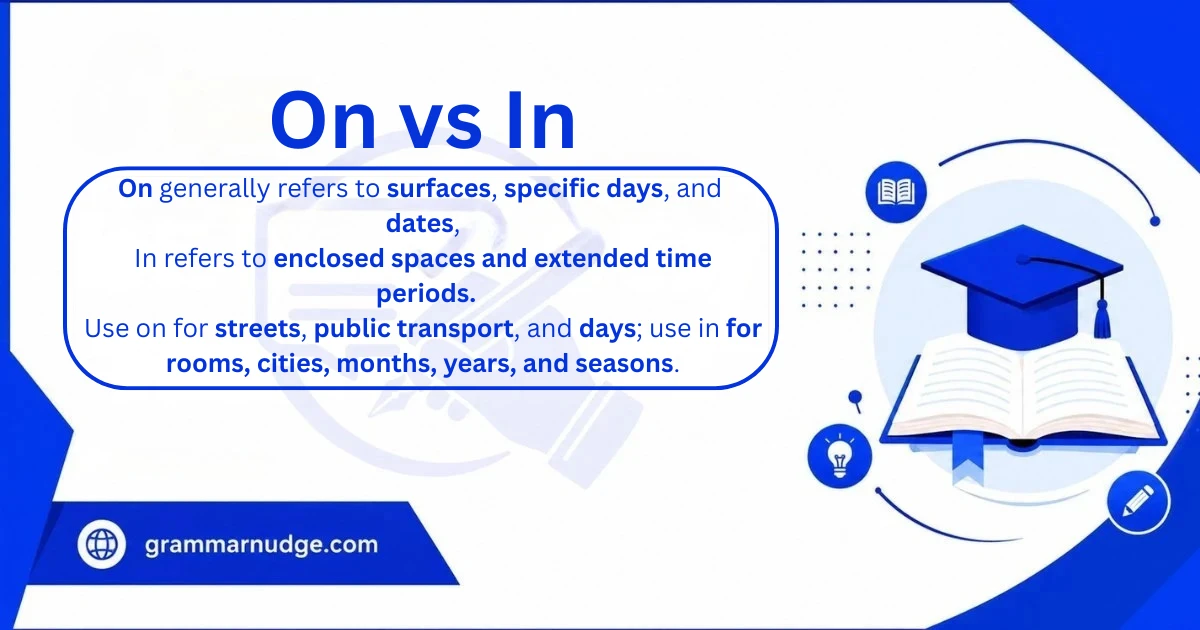
Use on for surfaces and for specific days or dates. Use in for enclosed spaces and for longer time periods, like months and years.
We say “on the table” and “on Friday.” We also say “in the box” and “in March.”
When to Use On
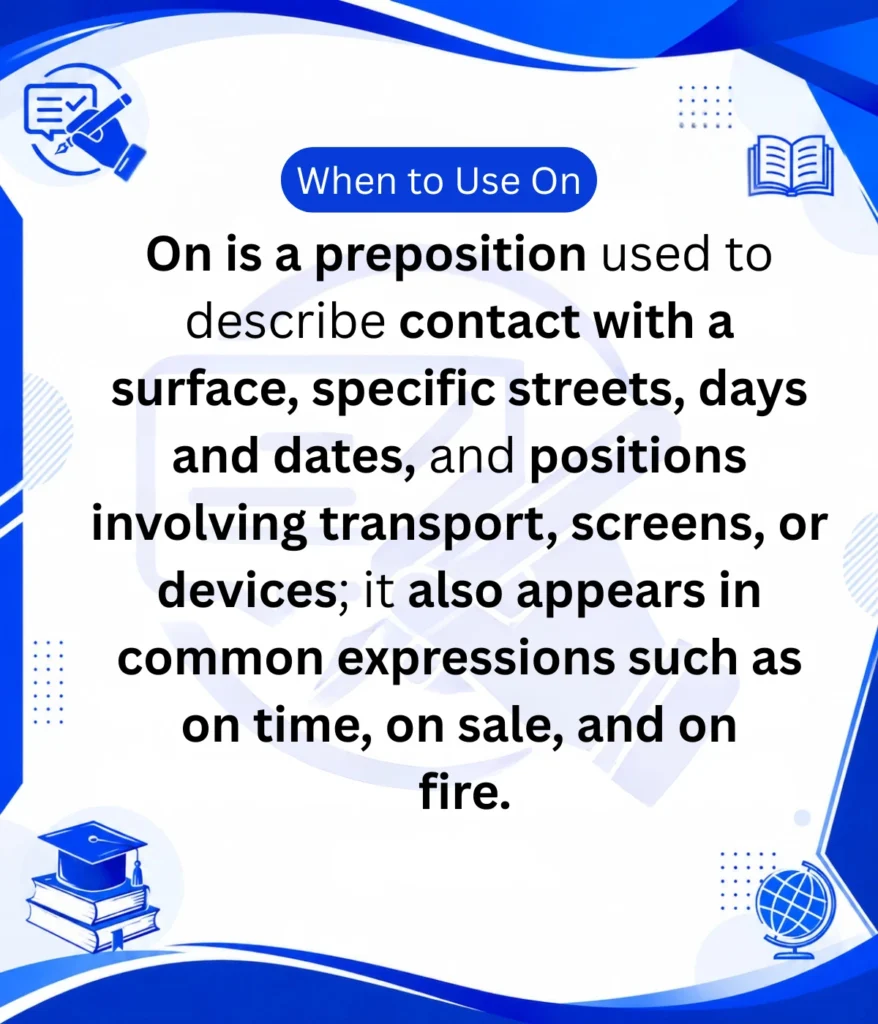
On shows that something touches a surface. It also points to a specific day or date.
- Surfaces: on the table, on the wall, on the floor
- Streets: on Main Street
- Days and dates: on Monday, on July 4
- Public transport: on the bus, on the train, on the plane
- Screens and devices: on the phone, on TV, on a website
On also appears in set phrases. Common ones are on time, on sale, and on fire.
More Posts:Does vs Do – Meaning, Difference, and Examples
When to Use In
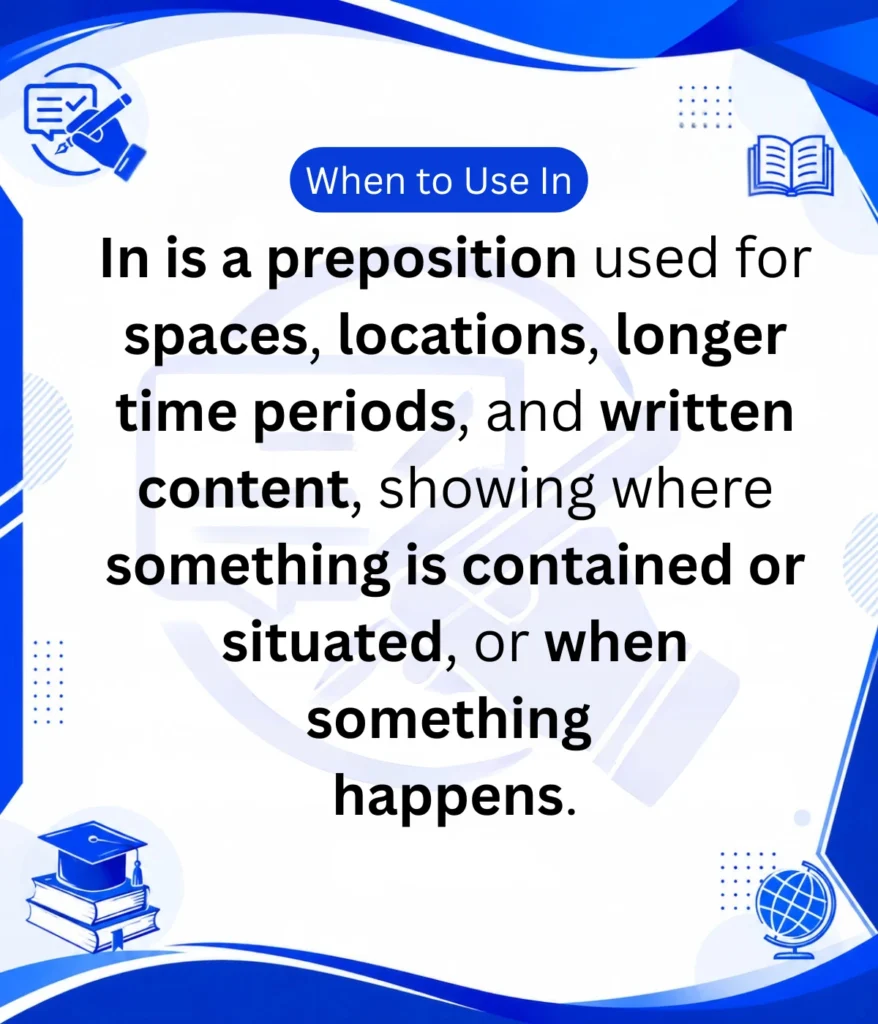
In shows that something sits inside a space. That space can be a box, a room, or a whole city or state.
We say
- “the keys are in the drawer”
- “she lives in Texas.”
We also use in for longer time spans, such as
- “in May,” “in 2024,”
- “in the summer.”
In works for written material too. We say “in a book,” “in an email,” or “in the article.”
More Posts:Yours vs Your – Meaning, Difference, and Examples
On vs In
| Feature | On | In |
|---|---|---|
| Core meaning | Touching a surface | Inside a space |
| Time | Days and dates | Months, years, seasons |
| Place | Streets, floors, walls | Rooms, cities, states |
| Transport | Bus, train, plane | Car, taxi |
| Example | The book is on the desk. | The book is in the bag. |
On vs In for Place
A street takes on, but a city takes in. So we say “on Elm Street in Denver.”
Think of surface versus space. A picture hangs on the wall. A person stands in the room.
When the Surface-or-Space Rule Doesn’t Work
The surface-or-space idea covers most cases, but English has a few habits that don’t follow it neatly. Pictures and screens are a good example.
We say a person is in a photo because they appear inside the frame. We say the photo hangs on the wall because it touches a surface. The same split shows up with media: in the newspaper or in a magazine, but on the radio, on TV, and on the internet.
Some phrases are simply fixed, and logic won’t help. People wait in line in the US, but they wait on line in parts of New York City. Someone sits in an armchair but on a chair. A person is in the car but on the bus.
When a phrase feels unclear, check whether it is a common set expression before applying the rule. If it is, learn it as a unit.
More Posts:Among or Amongst – Meaning, Differences & Usage
FAQs About On vs In
Is it “on the bus” or “in the bus”?
Say on the bus. Use on for buses, trains, and planes, and use in for cars and taxis.
Is it “on the weekend” or “in the weekend”?
Say on the weekend in the US. “In the weekend” is not standard, and the UK usually says “at the weekend.”

Hi, I’m John Henry, the voice behind Grammar Nudge. I make grammar simple and easy to understand, from basic rules to advanced writing tips. Clear explanations. Practical examples. No confusion.
Related Posts