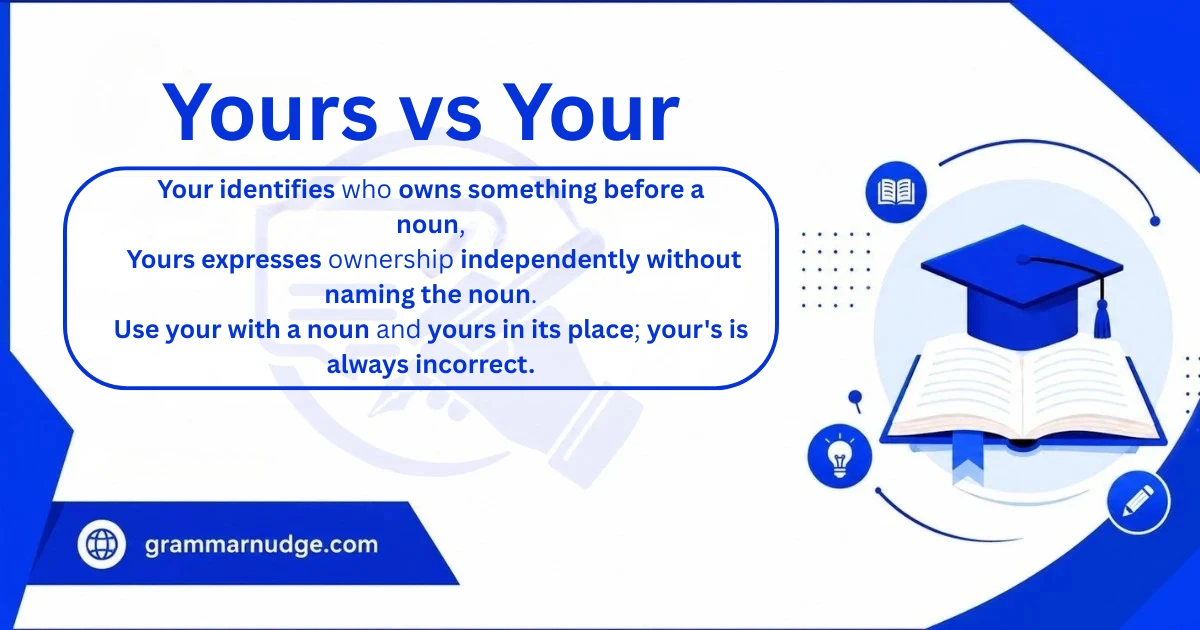
The difference between yours vs your is simple. Your comes before a noun, and yours stands alone. “Your bag” and “the bag is yours” show the rule.
Your is a possessive adjective. Yours is a possessive pronoun.
What Does “Your” Mean?
Your shows ownership. It tells us something belongs to the person we are talking to. A noun must always follow it.
It also shows a link between people, like “your sister” or “your boss.”
- Is this your phone?
- Your idea worked well.
- I love your shoes.
What Does “Yours” Mean?
Yours takes the place of a noun, so nothing follows it. “Is this jacket yours?” means “Is this your jacket?” The second version repeats the noun, and yours saves the extra word.
It also works after “of.” For example, “She is a friend of yours.”
More Posts:Among or Amongst – Meaning, Differences & Usage
Is Yours Singular or Plural?
Yours can be singular or plural. The word never changes. The verb depends on the noun it replaces.
- One thing: “My key is here, and yours is on the desk.”
- Many things: “My keys are here, and yours are on the desk.”
The same rule works for mine, hers, ours, and theirs.
Yours in Letters and Common Phrases
Some phrases with yours are fixed. We see them often in emails, cards, and speech.
- Yours truly: a closing for a letter or email
- Yours sincerely: a formal closing
- You and yours: you and your family
- A friend of yours: one of your friends
Yours vs Your
Both words show that something belongs to “you.” They just do the job in different ways.
| Word | Part of Speech | Needs a Noun? | Example |
|---|---|---|---|
| Your | Possessive adjective | Yes | Your coat is on the chair. |
| Yours | Possessive pronoun | No | The coat on the chair is yours. |
According to ProWritingAid, your shows up about 44 times more often than yours. So the stand-alone form is the rarer one.
More Posts:Dialog or Dialogue – Meaning, Differences & Usage
Easy Trick to Remember Yours vs Your
Your has an object; yours is the object. In “your dog,” the dog is the object. In “the dog is yours,” the word yours is the object.
You can also use a quick check:
- A noun comes right after the word? Use your.
- Nothing comes after it? Use yours.
Yours vs Your in Everyday Sentences
Here is how the your or yours choice looks in real life.
- Text: “I forgot my charger. Can I use yours?”
- School: “Please hand in your homework.”
- Work: “The desk by the window is yours.”
- Email: “Thanks for your help. Yours truly, Sam.”
Never write your’s. Possessive pronouns like yours, hers, and ours do not take an apostrophe.
Conclusion
Use your when a noun follows. Use yours when it stands alone. Remember the trick: your has an object; yours is the object.
More Posts:Per Say or Per Se – Meaning, Differences & Usage
FAQs About Yours vs Your
What is the difference between yours and your?
Your is a possessive adjective and comes before a noun. Yours is a possessive pronoun and stands on its own.
Is “your’s” correct?
No. Your’s is always a spelling mistake. The correct form is yours, with no apostrophe.
Can I say “yours truly” in an email?
Yes. It is a valid closing, but it sounds formal or a bit playful. Many people choose “Sincerely” or “Best” instead.
Is “at yours” used in US English?
Not often. “At yours” means “at your place” and is mostly a casual British phrase. In the US, we usually say “at your place.”

Hi, I’m John Henry, the voice behind Grammar Nudge. I make grammar simple and easy to understand, from basic rules to advanced writing tips. Clear explanations. Practical examples. No confusion.
Related Posts