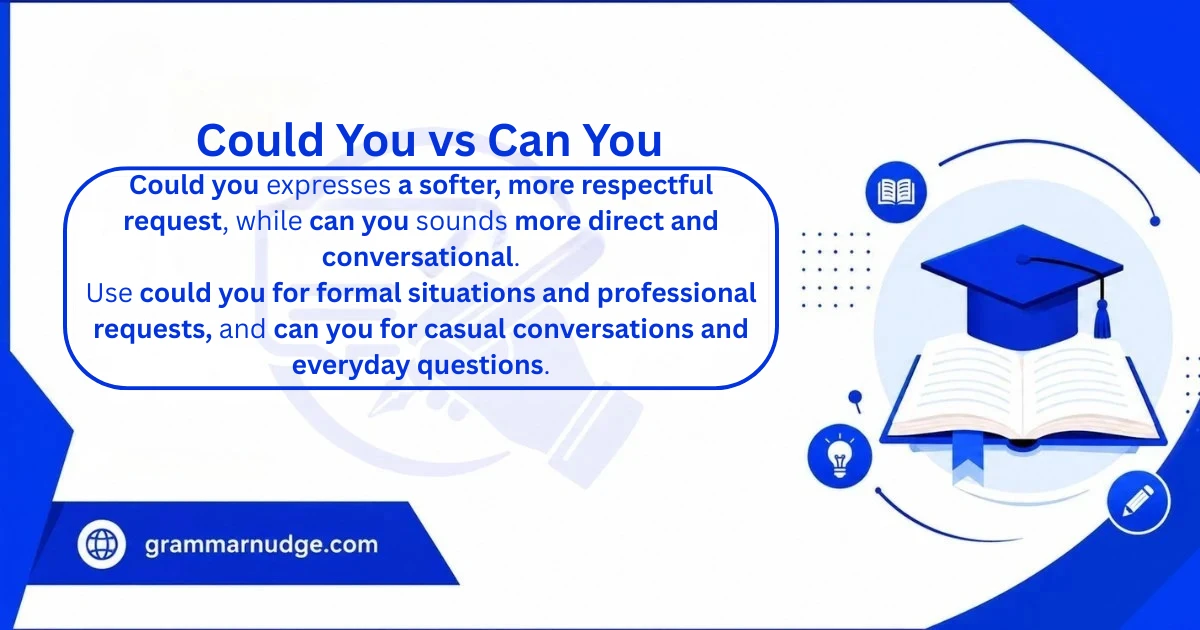
Could you vs can you comes down to tone. “Could you” is softer and more polite, and “can you” is more direct and casual. Both are correct in everyday English.
Use “could you” with managers, clients, and strangers. Use “can you” with friends, family, and close coworkers.
What Does “Can You” Mean?
“Can you” is a direct question. It uses the modal verb “can” to ask about ability, permission, or a simple request.
Can You for Ability
Here, we ask if someone is able to do something. The question is about skill.
- Can you swim?
- Can you speak Spanish?
- Can you lift this box?
Can You for Casual Requests
“Can you” is short and quick, so it sounds relaxed. It fits everyday requests between people who know each other.
Can you pass the salt?
Can you call me later?
Can You for Permission
“Can” is also common for asking permission. It sounds casual, though. The most formal choice is “may,” as in “May I sit here?”
More Posts:A vs The – Meaning, Difference, and Examples
What Does “Could You” Mean?
“Could you” is a polite request. It makes the question sound softer and less pushy.
Could You for Polite Requests
We use “could you” at work, in emails, and with people we do not know well. It signals respect and good manners.
- Could you send me the report by noon?
- Could you tell me where the station is?
- Could you please close the door?
Is “Could You” Past Tense?
No, not in a request. “Could” is the past tense of “can,” but “Could you help me?” asks about now, not yesterday.
The word only adds politeness. It works as an indirect request.
Could You for Suggestions
“Could” also offers ideas. “You could try the side entrance” is a suggestion, not a question.
More Posts:On vs In – Meaning, Difference, and Examples
Could You vs Can You
Both phrases ask for the same thing. The gap is in tone, formality, and how direct they sound.
| Feature | Could You | Can You |
|---|---|---|
| Politeness level | High | Medium |
| Tone | Soft, indirect | Direct, casual |
| Best used with | Managers, clients, strangers | Friends, family, close coworkers |
| Common setting | Emails, meetings, customer service | Daily chats, quick questions |
| Example | Could you help me with this? | Can you help me with this? |
Politeness and Tone
“Could you” feels like an open door. The other person can easily say no. “Can you” feels more like a straight question.
Formal vs Casual Situations
Match the phrase to the setting. In a formal setting, pick “could you.” In a casual chat, “can you” is fine.
Can You vs Could You at Work
At work, the right phrase helps you sound professional. A small word choice can change how a message lands.
In Emails
In a first email or a note to a boss, “could you” is the safer choice. With a close teammate, “can you” reads as normal and friendly.
- Could you review the draft by Friday?
- Can you send me the link?
In Meetings and Customer Service
Customer service teams lean on “could you” because it sounds calm and courteous. Adding “please” raises the politeness of either phrase.
Could You vs Can You Examples
Examples make the tone difference easy to hear.
With Friends and Family
- Can you pick me up at six?
- Can you turn the music down?
- Can you grab milk on the way home?
With Managers, Clients, and Strangers
- Could you share the meeting notes?
- Could you let me know when the order ships?
- Could you point me to the front desk?
Could You vs Would You
“Could you” asks if someone is able to do something. “Would you” asks if they are willing. Both are polite requests.
- Could you open the window? (Are you able to?)
- Would you open the window? (Are you willing to?)
In daily talk, people use the two almost the same way.
When “Could You” Still Feels Too Direct
Sometimes neither phrase feels right. You might be asking a favor that takes real effort, or writing to someone senior who owes you nothing. In that case, a softer opening helps.
- Could you please send me the file?
- Would you mind sending me the file?
- I was wondering if you could send me the file.
- Would it be possible for you to send me the file?
Notice the grammar shift in the second one. “Would you mind” is followed by an -ing verb, so you say “Would you mind helping me?” and not “Would you mind help me?”
A good rule of thumb: The bigger the favor, the longer the phrase. A quick question needs only “can you.” A request that costs someone time deserves “I was wondering if you could.”
More Posts:Does vs Do – Meaning, Difference, and Examples
Conclusion
The choice is simple. Use “could you” for polite, formal requests. Use “can you” for casual, direct questions. Both are correct, so pick the one that fits the moment.
Could You vs Can You FAQs
Is “could you” more polite than “can you”?
Yes. “Could you” sounds softer and more respectful because it is an indirect request. “Can you” is more direct.
Is “can you” rude?
No. “Can you” is normal and correct. It only sounds blunt in very formal settings, so add “please” to soften it.
Can I use “can you” in a professional email?
Yes, with colleagues you know well. For managers, clients, or first emails, “could you” is the safer pick.
Which one should I use at work?
Use “could you” for managers, clients, and new contacts. Use “can you” for close teammates and quick chats.
What is the difference between “could you” and “would you”?
“Could you” asks about ability. “Would you” asks about willingness. Both sound polite.
Is there a difference between American and British English for these phrases?
No real difference. Both “could you” and “can you” are standard in US and UK English, and the rules are the same.

Hi, I’m John Henry, the voice behind Grammar Nudge. I make grammar simple and easy to understand, from basic rules to advanced writing tips. Clear explanations. Practical examples. No confusion.
Related Posts