
Into vs on comes down to movement and position. Use into when something moves from outside to the inside of a space, like “She walked into the room.”
Use on when something rests on a surface, like “The book is on the table.”
Simple Rule to Remember
- Is something moving inside a space? Use into.
- Is something resting on top of a surface? Use on.
A quick test also helps. If “inside” fits the sentence, choose into. If “on top of” fits, choose on.
What Does “Into” Mean?
Into is a preposition of direction. It shows a path from outside to inside. The place can be a room, a car, a box, or even water.
- The dog ran into the garage.
- Pour the milk into the glass.
- We dove into the pool.
Using Into for Change and Interest
Into also shows change. Water turns into ice. A hobby grows into a business. We break into laughter or divide a class into groups.
It can also show interest. “I’m really into jazz” means you enjoy jazz a lot. No one is moving anywhere. The word just says you are deeply involved.
More Posts:A vs The – Meaning, Difference, and Examples
What Does “On” Mean?
On means touching a surface. The surface can be flat, like a floor or a beach. It can also be upright, like a wall. We also use on for body surfaces, as in “a tattoo on his arm.”
- The cup is on the counter.
- She hung the photo on the wall.
- There’s a fly on the window.
Using On for Days, Dates, and Devices
On works with specific days and dates: on Friday, on July 4. It also fits screens and devices: on the phone, on the website, on TV. If a device is running, we say it is on.
One small exception applies to writing. We say something appeared in a blog post or in an article, not on one.
Into vs On
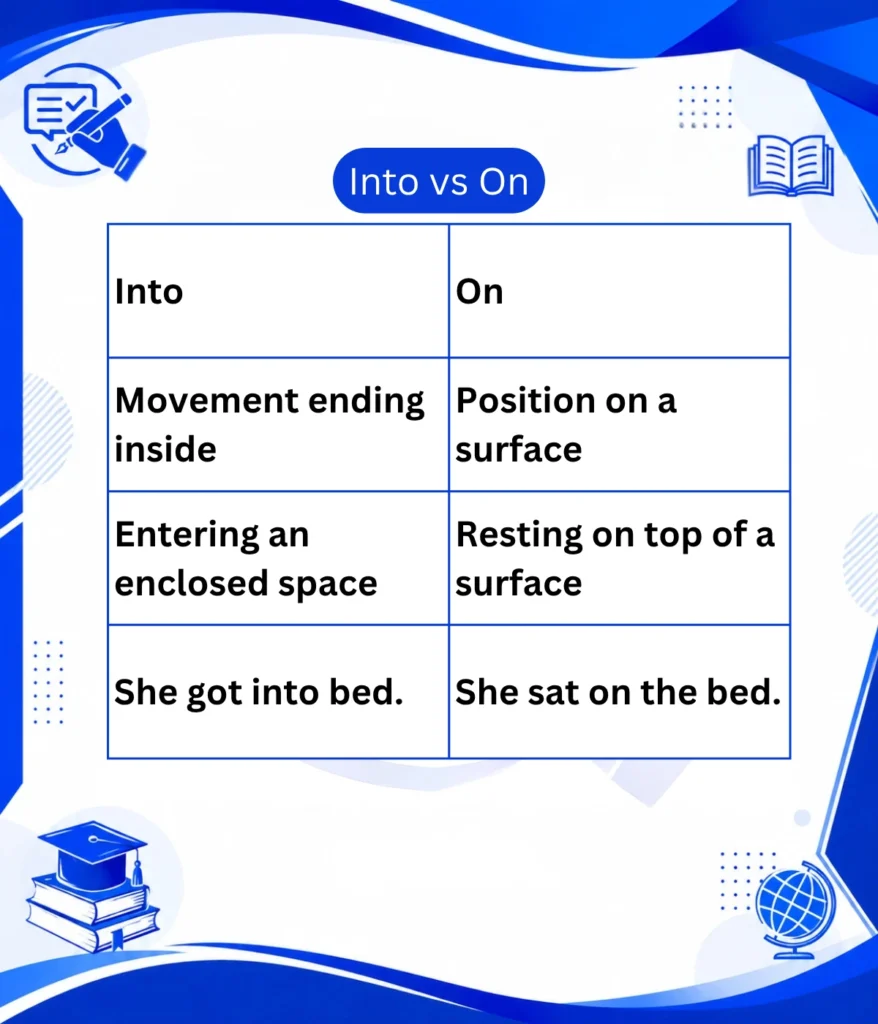
Movement vs Position
Into describes a trip that ends inside. On describes where something sits. That is the main gap between the two words.
“She walked on the stage” can mean she was already on the stage. “She walked onto the stage” means she came from offstage. Movement toward a surface needs onto, which we cover below.
Into vs On in the Same Sentence
One small word change can shift the whole picture.
- She got into bed. She slid under the covers.
- She sat on the bed. She stayed on top of the blanket.
More Posts:On vs In – Meaning, Difference, and Examples
Into vs On Examples in Everyday Sentences
At Home and at Work
- Drop the mail into the box. The mail is on the shelf.
- Walk into the meeting room. Your laptop is on the desk.
- Pour the coffee into the mug. The mug is on the table.
- Slide the file into the folder. The folder is on her desk.
In Texting and Online English
Online life follows the same logic. We save a photo into an album. We post a link on a website. We say “I’m on my phone” when we’re using it.
For accounts, we usually write “log in to your account.” The next sections explain why that is two words.
Into vs On vs Onto
When Onto Replaces On
Onto blends movement with on. It shows motion that ends on a surface. Think of it as “moving on top of.”
- The cat jumped onto the counter.
- The singer stepped onto the stage.
If the cat was already there, use on: “The cat sat on the counter.”
On To vs Onto
“On to” is two words when on belongs to the verb. “Move on to the next step” is correct. “Move onto the next step” can sound like you’re climbing on top of a step.
When in doubt, check the verb. “Move on” and “carry on” are verbs on their own, so to stays separate.
When “In” Is the Better Choice Than “Into”
Sometimes neither into nor on is right, because nothing is moving and nothing sits on a surface. The thing is simply inside a space. That is where plain in belongs.
She is in the kitchen. / She walked into the kitchen.
The keys are in the drawer. / He dropped the keys into the drawer.
The first sentence in each pair describes where something is. The second describes how it got there. Into needs a movement, in does not.
More Posts:Could You vs Can You – Meaning, Difference, and Examples
Into vs On FAQs
What is the difference between into and on?
Into shows movement to the inside of something. On shows position on a surface. “Walk into the room” and “sit on the chair” show the gap.
Can I use “on” instead of “onto”?
Yes, when nothing is moving. “The cat sat on the counter” is fine. For movement, onto is clearer: “The cat jumped onto the counter.”
Is it “log in to” or “log into”?
“Log in to your account” is the safest form, since “log in” is the verb. “Log into” is also common in everyday writing.
Is it “on the bus” or “in the bus”?
Use on the bus. Larger vehicles like buses, trains, and planes take on. Cars take in.
Is “into” one word or two?
It is one word when it shows movement or change. It becomes “in to” only when to starts a verb or a new phrase.
Do US and UK writers treat into vs on differently?
No. The rules for into, on, onto, and “in to” are the same in both. Grammar Monster notes that these choices don’t depend on UK or US writing conventions.
Conclusion
Into vs on is simple once you picture the action. If something moves inside, choose into. If something rests on a surface, choose on. Keep the bus-and-car exception in mind, and your sentences will read clean.

Hi, I’m John Henry, the voice behind Grammar Nudge. I make grammar simple and easy to understand, from basic rules to advanced writing tips. Clear explanations. Practical examples. No confusion.
Related Posts