Canceled is the correct spelling in the United States. Cancelled is the version used in the UK. Both spellings mean the same thing, and both are grammatically valid.
The difference comes down to which country’s spelling rules you’re following.
Canceled vs Cancelled
Canceled uses one L, and it’s the standard spelling for US writing, from emails to news articles. Cancelled uses two L’s and shows up in British publications instead.
Neither spelling is “wrong.” They’re just two accepted versions of the same past tense verb.
The Simple Rule
Here’s the easiest way to remember it:
- One L = canceled (US)
- Two L’s = cancelled (UK)
That’s really all you need to know for everyday writing.
Why Both Spellings Are Technically Correct
Dictionaries on both sides of the Atlantic list canceled and cancelled as acceptable. Neither is a typo. The split comes from different spelling conventions that developed over time, not from one version being more “official” than the other.
More Posts:Gases vs Gasses – Meaning, Differences & Usage
What Does “Canceled” Mean?
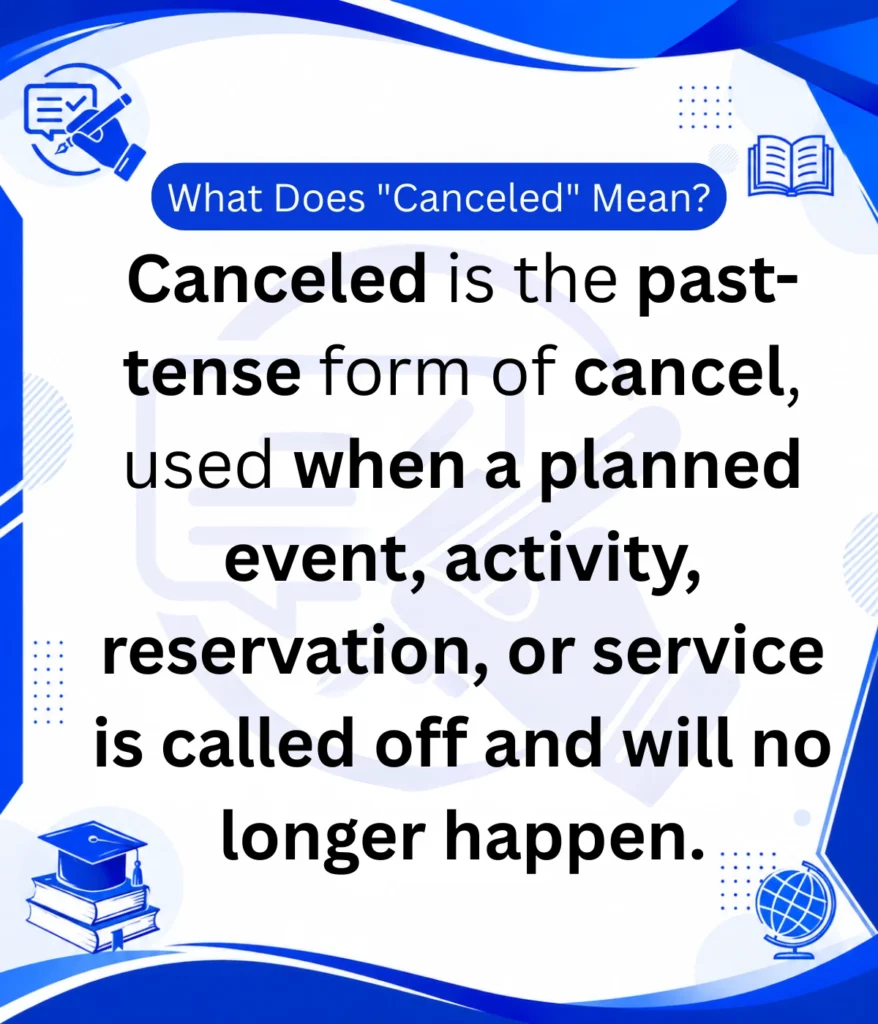
Canceled is the past tense of the verb cancel, meaning to call something off, revoke it, or make it void. You’ll see it constantly in flight delays, event postponements, and subscription notices.
Definition and Usage
When something is canceled, it no longer happens. A meeting, a flight, a reservation, a magazine subscription — all of these can be canceled. The word works the same way whether you’re talking about a small plan or a major event.
Example Sentences Using “Canceled”
- The flight was canceled due to heavy storms.
- She canceled her gym membership last week.
- The concert got canceled after the venue flooded.
What Does “Cancelled” Mean?
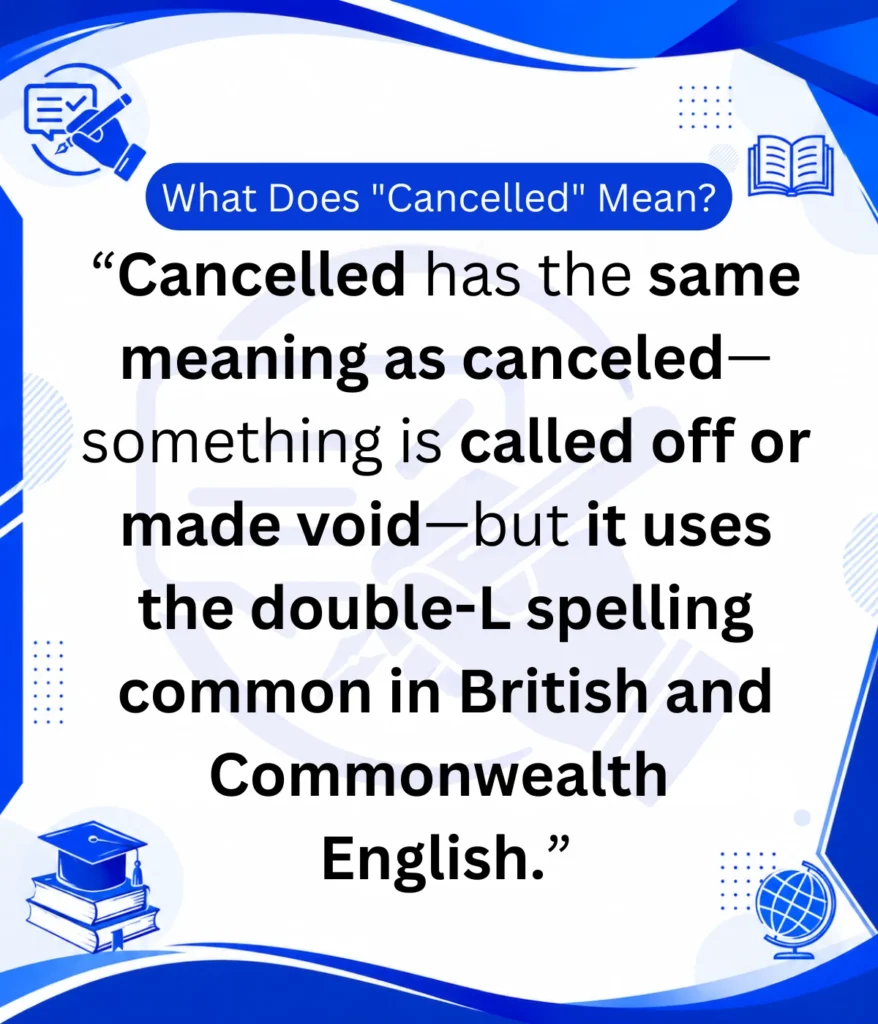
Cancelled carries the exact same meaning as canceled — it just uses the double-L spelling found in British and Commonwealth writing.
Definition and Usage
If you’re reading a UK newspaper or a British company’s website, you’ll likely spot cancelled instead of canceled. The meaning doesn’t shift at all; only the spelling changes.
Example Sentences Using “Cancelled”
- The match was cancelled because of rain.
- He cancelled the order before it shipped.
- Their trip got cancelled last minute.
Canceled or Cancelled
The core difference isn’t grammar — it’s regional spelling.
| Word Form | US Spelling | UK Spelling |
|---|---|---|
| Past tense | canceled | cancelled |
| Present participle | canceling | cancelling |
| Noun | cancellation | cancellation |
US Spelling Rule
In US writing, we typically don’t double the final consonant of cancel when adding -ed or -ing. This follows a broader pattern seen in similar words like traveled and modeling.
More Posts:Benefiting vs Benefitting – Meaning, Differences & Usage
Other Words That Follow the Same Pattern
Cancel isn’t the only verb where US and UK spelling splits over a doubled consonant. The same single-L-in-America rule shows up in several everyday words:
Other Words That Follow the Same Pattern
Cancel isn’t the only verb where US and UK spelling splits over a doubled consonant. The same single-L-in-America rule shows up in several everyday words:
- Traveled / Travelled — “She traveled to Chicago” (US) vs. “She travelled to London” (UK)
- Modeled / Modelled — “He modeled the new design” (US) vs. “He modelled the new design” (UK)
- Labeled / Labelled — “The box was labeled fragile” (US) vs. “The box was labelled fragile” (UK)
- Fueled / Fuelled — “The debate fueled controversy” (US) vs. “The debate fuelled controversy” (UK)
If you can remember canceled, you already know the pattern for the rest of these — one L in American English, two in British English, whenever the base word ends in a single vowel plus L.
Where the Spelling Difference Came From
This split traces back to early dictionary standardization in the 1800s. Lexicographer Noah Webster favored simpler, streamlined spellings for US dictionaries, which is why single-L forms like canceled stuck around while double-L forms remained standard elsewhere.
Canceling or Cancelling — Which Should You Use?
The same one-L-versus-two-L pattern carries over into the -ing form of the word.
Canceling
Canceling is the more common spelling for ongoing or future action — for example, “I’m canceling my subscription today.” This matches the same consonant rule as canceled.
Cancelling
Cancelling is the double-L version used elsewhere. If you’re reading content written for a British audience, this is the spelling you’ll usually run into.
FAQs About Canceled or Cancelled
Is it “canceled” or “cancelled” in the USA?
Canceled, with one L, is the standard spelling used across US publications, media, and everyday writing.
Which spelling does AP Style use?
The Associated Press Stylebook, widely used by US journalists, recommends canceled and canceling with a single L.
Is “cancelled” grammatically incorrect?
No. Cancelled isn’t wrong — it’s simply the standard spelling in British English, while canceled is standard in American English.
Do “canceling” and “cancelling” follow the same rule?
Yes. Canceling pairs with the single-L US spelling, while cancelling pairs with the double-L UK spelling.
Is “cancellation” spelled the same in US and UK English?
Yes. Cancellation keeps its double L in both versions of English — it’s one of the few forms that doesn’t change.
Can I use “cancelled” in American writing?
You can, and readers will understand it, but canceled is the more consistent choice for US-facing content.
Conclusion
Both canceled and cancelled are correct — the choice simply depends on which spelling convention you’re writing for. For US content, stick with canceled, canceling, and cancellation, and your writing will stay consistent and polished throughout.

Hi, I’m John Henry, the voice behind Grammar Nudge. I make grammar simple and easy to understand, from basic rules to advanced writing tips. Clear explanations. Practical examples. No confusion.
Related Posts