
Use there is no with singular and uncountable nouns, and use there are no with plural countable nouns.
The rest of this guide shows you exactly how to apply it, including the tricky cases that trip up even confident writers.
There Is No vs There Are No
The choice comes down to countability, not meaning. Look at the noun right after “no.” If it names one thing or a substance, use is. If it names more than one thing, use are.
The word “there” is a placeholder. It doesn’t control the verb — the noun does. This single fact solves most confusion around there is no vs there are no.
| Noun Type | Example Noun | Correct Phrase | Example Sentence |
|---|---|---|---|
| Singular countable | book | There is no | There is no book on the desk. |
| Uncountable | water | There is no | There is no water in the glass. |
| Plural countable | books | There are no | There are no books on the shelf. |
More Posts:Combating vs Combatting – Meaning, Differences & Usage
There Was No vs There Were No
The same countability rule applies once the sentence moves into the past — only the verb form changes. Singular and uncountable nouns pair with was; plural countable nouns pair with were.
- There was no milk in the fridge this morning.
- There was no reply to her email.
- There were no seats left by the time we arrived.
- There were no witnesses to the accident.
Writers sometimes default to “was” across the board because it sounds smoother in speech, but formal writing still expects were before any plural noun, exactly as are is expected in the present tense.
If you’d naturally use is with the noun in present tense, use was in the past. If you’d use are, use were.
There Is No — Meaning and Usage
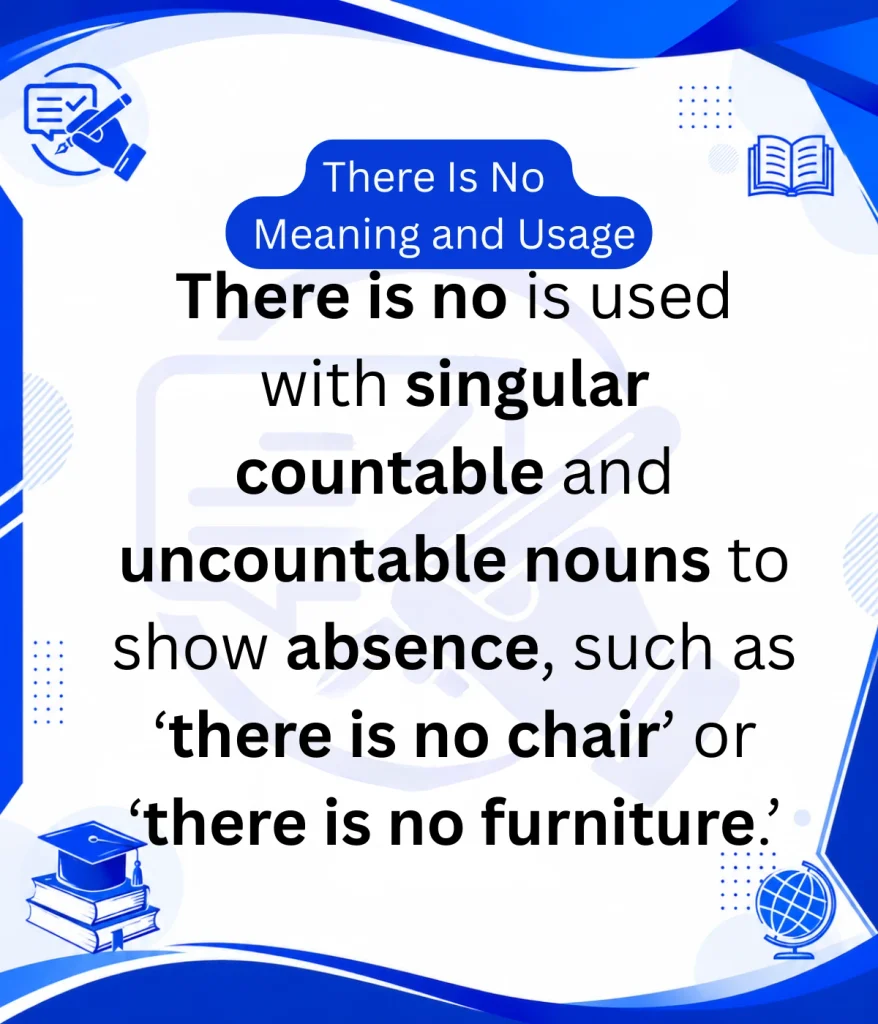
There is no signals that one thing, or an amount of something, doesn’t exist. It’s the more common of the two phrases by a wide margin — data from Google’s Ngram Viewer shows “there is no” has outpaced “there are no” in published English since the early 1900s.
There Is No With Singular Nouns
Singular nouns name one countable item — a chair, a phone, an idea. When exactly one of that thing is missing, the sentence needs is.
- There is no chair in the room.
- There is no answer to that question.
- There is no reason to wait any longer.
A fast test: if the noun sounds natural after “a” or “an,” it’s singular, and there is no fits.
There Is No With Uncountable Nouns
Uncountable nouns — also called mass nouns — describe substances or concepts you can’t split into single units. Water, sugar, furniture, and advice all fall here.
- There is no sugar left in the jar.
- There is no furniture in the new apartment.
- There is no advice that fits every situation.
These nouns behave like singular subjects even when they represent a large quantity, which is why “there are no furnitures” is always wrong.
There Are No — Meaning and Usage
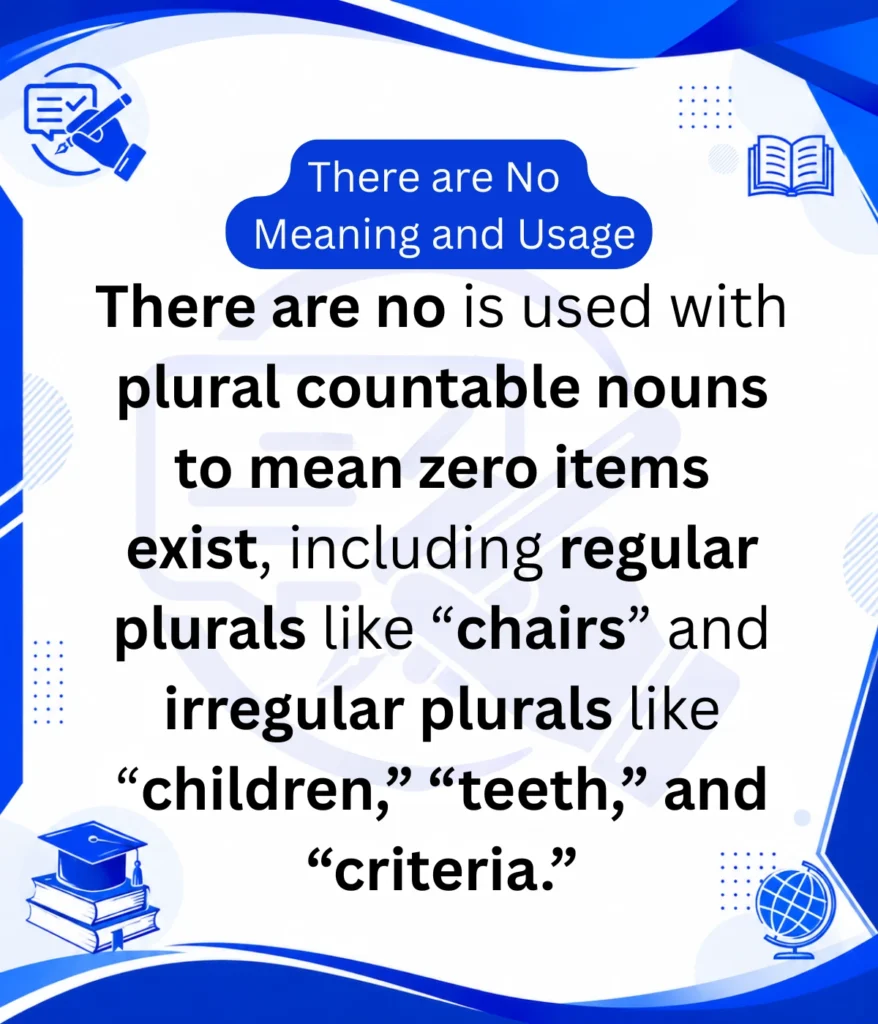
There are no points to zero items within a group of countable things. If you can put a number in front of the noun — three chairs, ten books — the phrase needs are when that number drops to zero.
There Are No With Plural Countable Nouns
Plural nouns typically end in -s and name more than one item.
- There are no chairs in the hallway.
- There are no tickets left for tonight’s show.
- There are no easy answers here.
A quick check: if “many” fits naturally before the noun, the noun is plural, and there are no is correct.
There Are No With Irregular Plurals
Some plurals don’t end in -s, which throws off the “check for an s” shortcut. Words like children, teeth, and criteria are still plural, so they still pair with are.
- There are no children in the yard.
- There are no criteria that match this search.
Treat these the same way you’d treat any plural noun — the spelling changes, but the grammar rule doesn’t.
More Posts:Hassle vs Hastle – Meaning, Differences & Usage
There Is No vs There Are No
Countable vs Uncountable Nouns
This is the real engine behind the rule. Countable nouns can be split into individual units and take a number directly (one apple, two apples). Uncountable nouns can’t — you measure them instead of counting them (a cup of water, not “one water”).
Uncountable nouns always take is, no matter how much of the substance you’re talking about.
Singular vs Plural Agreement
Once you know a noun is countable, the only remaining question is quantity. One item takes is. Two or more items take are. Zero of something uncountable still takes is, because uncountable nouns never pick up a plural form.
Tricky Cases That Confuse Even Native Speakers
Collective Nouns (Team, Staff, Family)
Collective nouns name a group of people but usually act as one unit, so they pair with is by default.
- There is no team available to cover this shift.
- There is no staff on duty right now.
If the sentence shifts focus to the individuals inside that group, switch to are: “There are no staff members available.”
Mass Nouns Used Countably
Some uncountable nouns turn countable when they refer to types or servings rather than the substance itself. Coffee is the classic example.
- There is no coffee left in the pot. (the drink as a whole)
- There are no coffees left on the menu. (specific drink options)
The rule doesn’t change — only the way the noun is being used does.
Fractions, Percentages, and Numbers
Numbers follow the noun they modify, not their own logic.
- There is no 50% discount on this item. (one discount)
- There are no 50% discounts available this month. (multiple instances)
Ignore the number. Check what it’s counting, then apply the standard rule.
FAQs About There Is No vs There Are No
Is it “there is no” or “there are no”?
Use there is no for singular or uncountable nouns, and there are no for plural countable nouns.
Is “there is no information” or “there are no informations” correct?
There is no information is correct — “information” is uncountable and has no plural form.
Can “there is no” ever be used before a plural noun?
No. Standard grammar requires there are no before any plural countable noun, even in casual speech.
Is “there’s no rules” grammatically correct?
No. It’s common in speech, but formal writing requires there are no rules, since “rules” is plural.
What’s the difference between “there is no” and “there isn’t any”?
They mean the same thing. There is no sounds more direct; there isn’t any sounds more conversational.
Conclusions
Getting there is no vs there are no right comes down to one habit: check the noun first, decide if it’s singular, uncountable, or plural, then let that choice pick the verb. Once that habit sticks, the rule becomes automatic.

Hi, I’m John Henry, the voice behind Grammar Nudge. I make grammar simple and easy to understand, from basic rules to advanced writing tips. Clear explanations. Practical examples. No confusion.
Related Posts