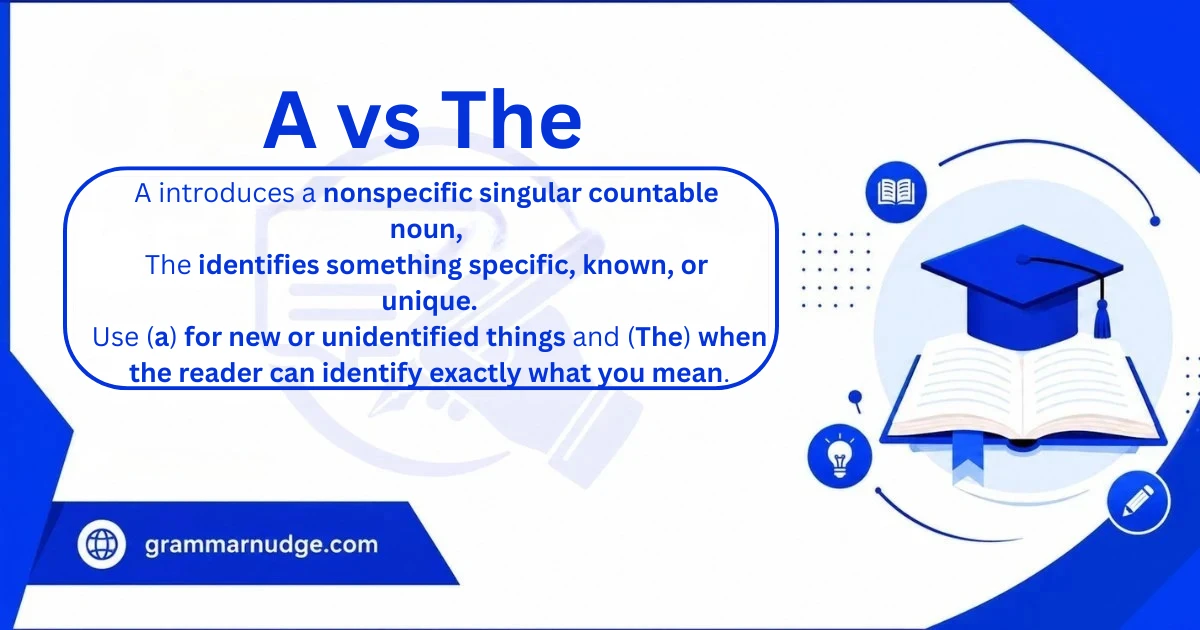
A vs the comes down to one idea. Use a for any one thing, and use the for one specific thing.
If the reader already knows which thing you mean, pick the. If not, pick a.
What Does “A” Mean in A vs The?
A is an indefinite article. It points to any one item in a group. It works only with singular countable nouns.
- I need a pen. (any pen)
- She is a teacher. (one of many teachers)
- We saw a movie last night. (new information)
Use a before a consonant sound, such as a book or a university. Use an before a vowel sound, such as an hour or an apple. The sound counts, not the letter.
More Posts:On vs In – Meaning, Difference, and Examples
What Does “The” Mean in A vs The?
The is a definite article. It points to one specific thing that both people already know. It works with singular, plural, and uncountable nouns.
Say “Pass me the salt” when only one salt shaker is on the table. Say “I love the mountains we visited” when you mean a known group.
The is also the most common word in English. That is why small slips with it stand out.
More Posts:Does vs Do – Meaning, Difference, and Examples
A vs The
| Feature | A / An | The |
|---|---|---|
| Type | Indefinite article | Definite article |
| Meaning | Any one, not specific | One specific, known |
| Noun type | Singular countable only | Singular, plural, uncountable |
| Typical use | New or unknown item | Item already known |
| Example | I bought a car. | I bought the car we saw. |
Ask, “Does my reader know which one I mean?” If yes, use the. If no, use a.
When to Use A or The
- Use a when you introduce something for the first time.
- Use the when you mention it again.
- Use the when only one exists.
- Use the when a phrase names it, as in “the book on the table.“
A or The: First Mention vs Second Mention
A new noun gets a. A repeated noun gets the.
“I adopted a dog. The dog loves long walks.”
A vs The With Unique Things and Names
Use the for one-of-a-kind things, such as the sun, the moon, and the internet. Use it with superlatives too, such as the best or the tallest.
Many place names take the, including the United States, the Nile, the Pacific Ocean, and the Rocky Mountains. Most single names do not, such as Texas, Paris, or Mount Everest.
When One Word Changes the Whole Meaning
Sometimes both articles are correct, but the sentence says something different. The article tells your reader how much they already know.
- I need a plumber. Any plumber will do.
- I need the plumber. You mean the one you already hired.
- She is a doctor. This describes her job.
- She is the doctor. She is the one everyone is waiting for.
The same shift appears in general statements. “A lion is a carnivore” talks about any one lion. “The lion is a carnivore” talks about lions as a species, which is common in formal writing.
More Posts:Yours vs Your – Meaning, Difference, and Examples
A vs The FAQs
What is the difference between a and the?
A refers to any one item. The refers to one specific item that the reader already knows.
Can you use a and the in the same sentence?
Yes. For example: “I bought a laptop, and the screen is sharp.” The first noun is new, and the second is known.
Do you use a or the with plural and uncountable nouns?
Never use a with them. Use the for something specific, such as “the water.” For general ideas, skip the article, as in “Water is vital.”
Is it “a” or “an” before words like hour and university?
Go by sound. Say an hour because the h is silent. Say a university because it starts with a y sound.
Why do some people say “go to hospital” and others “go to the hospital”?
This is the one clear US and UK difference. British English often drops the in “in hospital,” while US English keeps it: “in the hospital.”
Conclusion
Use a for any one thing and the for a known or unique thing. Introduce a noun with a, then call it the after that. With these simple rules, a or the gets easy to pick.

Hi, I’m John Henry, the voice behind Grammar Nudge. I make grammar simple and easy to understand, from basic rules to advanced writing tips. Clear explanations. Practical examples. No confusion.
Related Posts