Proved and proven both come from the verb “prove.” Use proven when you need an adjective before a noun (like a proven method), and use proved or proven when you need the past tense or past participle of “prove” (like she proved her point or she has proven her point).
Both are grammatically correct — the real skill is knowing which one fits your sentence.
What Does “Proved” Mean?
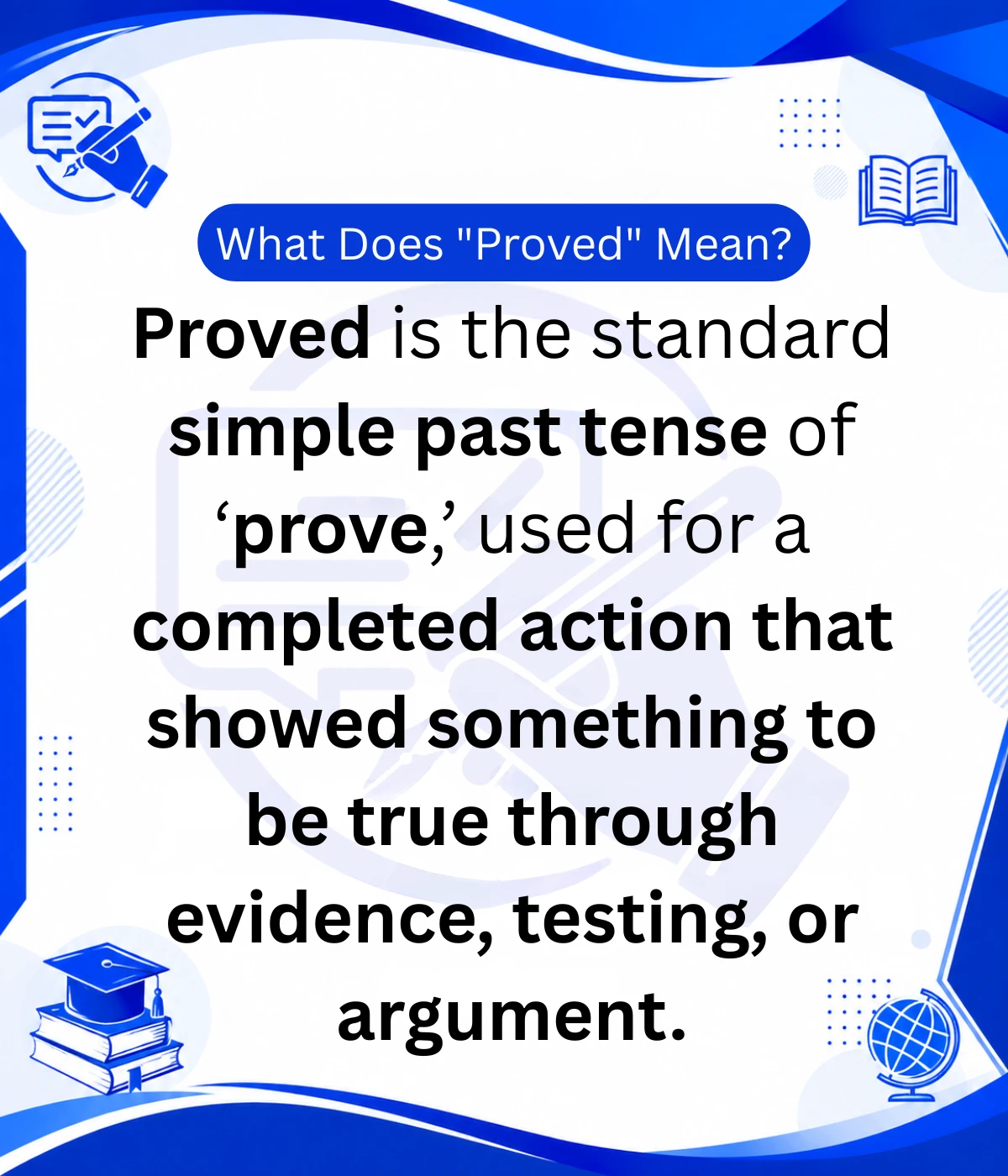
Proved is the standard simple past tense of “prove.” When something happened and finished in the past, proved is your word.
It’s also one of two accepted past participle forms, used after helping verbs like has, have, or had.
Definition of “Proved”
Proved means something was shown to be true through evidence, testing, or argument. It’s the action of proving, already completed.
“Proved” as Simple Past Tense
Whenever you’re describing a finished action, proved is always correct:
- The lawyer proved the client’s innocence.
- Her theory proved correct after years of testing.
- The results proved the drug’s effectiveness.
Example Sentences Using “Proved”
| Sentence | Function |
|---|---|
| He proved his loyalty. | Simple past tense |
| She has proved herself capable. | Past participle |
| The map proved useless. | Simple past tense |
More Posts:Toward or Towards – Meaning, Differences & Usage
What Does “Proven” Mean?
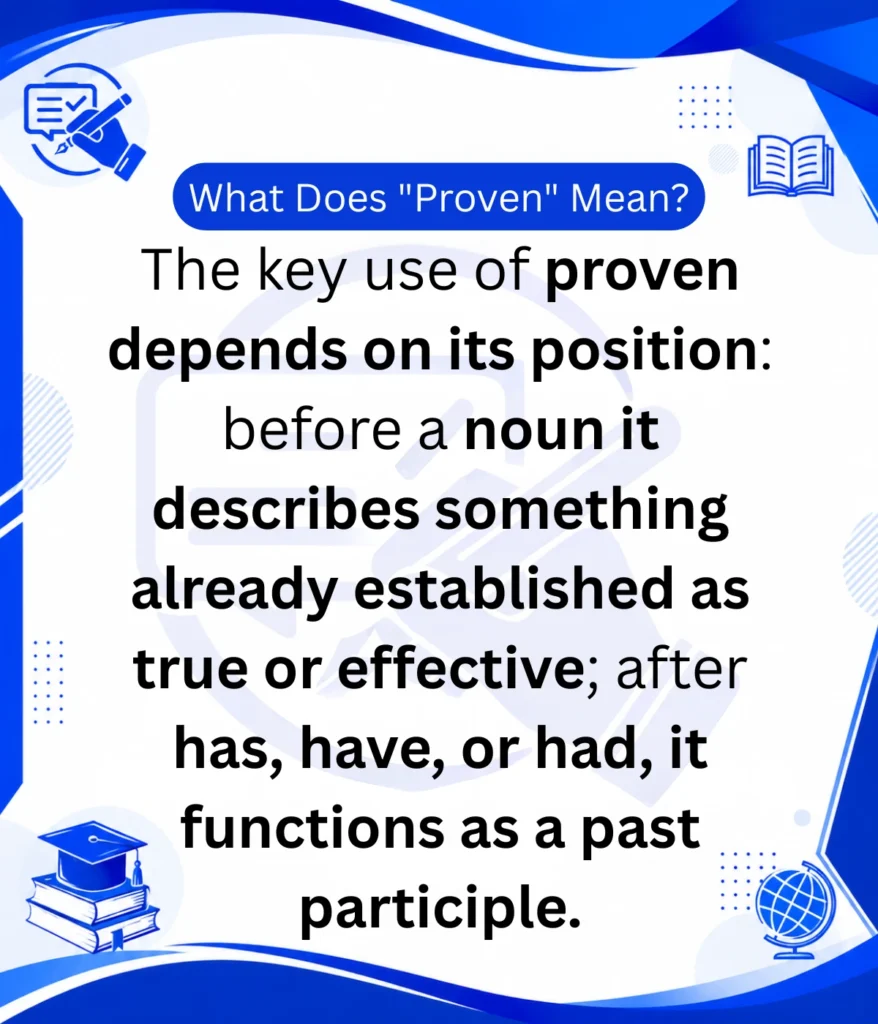
Proven wears two hats. It works as an adjective describing a noun, and it also works as an alternate past participle form of “prove.”
Definition of “Proven”
As an adjective, proven describes something that has already been established as true or effective — think proven results or a proven strategy.
“Proven” as an Adjective
This is where proven truly shines. It sits directly before a noun:
- a proven formula
- a proven track record
- proven benefits
“Proven” as a Past Participle
Proven also pairs with has, have, or had — an accepted alternative to proved:
- The vaccine has proven effective.
- Researchers have proven the link.
Example Sentences Using “Proven”
- Her methods are proven and reliable.
- The company has a proven approach to growth.
- He has proven himself time and again.
More Posts:Gray or Grey – Meaning, Differences & Usage
Proved vs. Proven: Key Grammar Differences
Proven leans toward describing nouns, while proved leans toward finishing actions.
Quick Rule: When to Use Each Word
- Before a noun? Use proven.
- Describing a completed action (no helping verb)? Use proved.
- After has/have/had? Either proved or proven works.
How to Choose Between Proved and Proven
Step 1: Is It Describing a Noun?
If yes, proven is your answer. It’s functioning as an adjective.
Step 2: Is It Completing a Verb Tense?
No helping verb, just a finished action? Use proved. That’s the simple past tense slot.
Step 3: Is There a Helping Verb Involved?
With has, have, or had, you’re free to choose proved or proven — both are considered standard.
Proved vs. Proven in Common Phrases
Certain set phrases have locked in one form over time, and knowing them helps you sound natural.
Legal and Everyday Set Phrases
- innocent until proven guilty
- a proven track record
- proven results
Business and Descriptive Phrases
- a proven formula
- a proven performer
- proven technology
These phrases stick with proven because they’re functioning as adjectives, describing the noun that follows.
FAQs About Proved vs. Proven
Is it “has proved” or “has proven”?
Both are correct. “Has proved” and “has proven” are interchangeable past participle forms — pick whichever sounds smoother in your sentence.
Which is correct, “proved” or “proven”?
It depends on the role. Use proven before a noun; use proved for simple past tense; use either after has/have/had.
Can “proved” and “proven” be used interchangeably?
Only as past participles (after helping verbs). As simple past tense, only proved works; as an adjective, only proven works.
Is “proven” grammatically correct?
Yes. Proven is fully accepted as both an adjective and a past participle in standard English today.
What is the past participle of “prove”?
Both proved and proven serve as valid past participles, though style guides often lean toward proved in formal writing.
Why do some sentences use “proved” and others “proven”?
It comes down to sentence role and regional habit — proven is more common as a past participle in the U.S. and Scotland, while proved is more common in British writing, though both appear on either side.
Conclusion
Proved and proven aren’t rivals — they’re teammates with different jobs. Use proven before nouns, proved for simple past tense, and either one after a helping verb. Once you see the pattern, the choice becomes automatic.

Hi, I’m John Henry, the voice behind Grammar Nudge. I make grammar simple and easy to understand, from basic rules to advanced writing tips. Clear explanations. Practical examples. No confusion.
Related Posts