Lunchtime is the correct spelling for almost every situation. It is one word, and it is the form listed first in major dictionaries. Lunch time, written as two words, still shows up in schedules and signs, but it is not the standard choice for everyday writing.
What Does “Lunchtime” Mean?
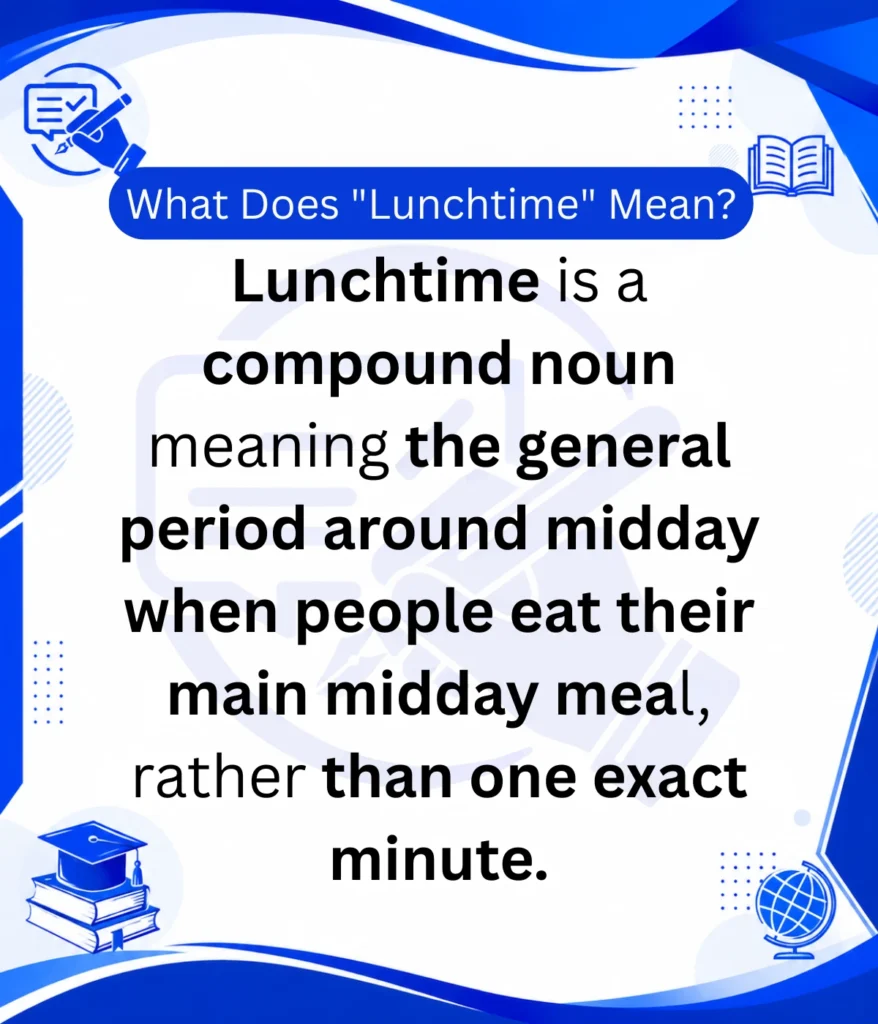
Lunchtime is a compound noun. It means the general period in the middle of the day when people stop to eat their midday meal.
This word covers more than one exact minute. It can mean a moment, a routine, or a whole stretch of the afternoon. That flexibility is why it works so well in normal writing.
Lunchtime in a Sentence
- I always check my email right before lunchtime.
- The café gets loud around lunchtime.
- She reads a book during lunchtime.
- Traffic slows down near lunchtime.
Notice how lunchtime works like “morning” or “evening.” It names a block of the day, not a fixed clock reading.
More Posts:Analysis vs Analyses – Meaning, Differences & Usage
What Does “Lunch Time” Mean?
Lunch time, split into two words, points to a specific scheduled moment. It works more like a label on a timetable than a general idea.
Writers reach for this form when they want to highlight the exact hour, not the loose daily window.
Lunch Time in a Sentence
- What lunch time does your office use today?
- Our lunch time moved to 12:45 this week.
- Please confirm the new lunch time before Friday.
Each example asks about or states a precise hour. That precision is the real signal for choosing the two-word form.
Lunchtime vs Lunch Time
The gap between these two forms is small but real. One is a fixed compound word. The other is a flexible phrase.
| Feature | Lunchtime | Lunch Time |
|---|---|---|
| Word type | Closed compound noun | Two-word noun phrase |
| Meaning | General midday period | Specific scheduled moment |
| Dictionary status | Standard headword | Valid variant |
| Best use | Everyday and formal writing | Schedules, labels, headings |
| Example | “See you at lunchtime.” | “Confirm the lunch time.” |
Why Lunchtime Is a Compound Noun
English often fuses two common words into one once people use them together enough. Lunchtime followed that same path as bedtime, daytime, and playtime.
This kind of merge makes reading faster. Your eyes process one clean word instead of splitting a phrase into two separate ideas.
When to Use Lunchtime vs Lunch Time
Picking the right form gets easy once you know the underlying rule. Ask yourself one simple question: general period, or exact moment?
That single question resolves almost every case you will run into.
Lunchtime in Everyday and Business Writing
Use lunchtime for blog posts, emails, reports, and normal conversation. It reads smoothly and matches what most readers expect to see.
- “Please send the file before lunchtime.”
- “Our team usually takes a walk at lunchtime.”
- “The gym fills up fast around lunchtime.”
Lunch Time in Schedules and Formal Contexts
Use lunch time when a document needs to name an exact hour, like a school timetable or a shift schedule. This form works well as a heading or label.
- “Lunch Time: 12:00–12:45”
- “New lunch time starts Monday.”
More Posts:Analog vs Analogue – Meaning, Differences & Usage
Lunchtime and Nearby Time Words
A lunch hour points to the length of the break itself, usually about sixty minutes. Noon means exactly 12:00, while midday covers the general stretch around that hour. Lunchtime stays broader than all three, covering however long a workplace, school, or routine sets aside for the midday meal.
Lunch schedules also shift by setting. Office workers often get a fixed thirty to sixty minutes, while school lunch periods run shorter and are frequently staggered across grade levels to manage cafeteria space.
FAQs About Lunchtime vs Lunch Time
Is “lunchtime” one word or two?
Lunchtime is written as one word in standard modern English and appears that way in Merriam-Webster and other major dictionaries.
Is “lunch time” grammatically correct?
Yes, lunch time is valid as a two-word phrase, especially when naming an exact scheduled hour rather than a general period.
Should I write “lunch-time” with a hyphen?
No. The hyphenated form is outdated and rarely appears in current style guides or dictionaries.
Is “lunchtime” different in British and American English?
Not really. Both British and American dictionaries list lunchtime as the standard spelling, so the choice does not depend on which side of the Atlantic you write for.
What is the difference between lunchtime and lunch break?
Lunchtime names the general period when lunch happens, while a lunch break refers to the pause taken away from work or school during that time.
Which form should I use in a resume or business email?
Use lunchtime. It is concise, standard, and fits naturally into professional writing.
Conclusion
Lunchtime is the safe, standard choice for nearly everything you write. Save lunch time for schedules and labels where an exact hour matters more than the general idea. Once you remember that one distinction, you will never second-guess this spelling again.

Hi, I’m John Henry, the voice behind Grammar Nudge. I make grammar simple and easy to understand, from basic rules to advanced writing tips. Clear explanations. Practical examples. No confusion.
Related Posts