Nighttime is the correct, modern spelling to use. It’s written as one word. Night time, as two separate words, is the older form and is rarely used in published writing today.
Below, you’ll find the full breakdown: what each form means, when (if ever) to use the two-word version, and how to keep your writing consistent and polished.
What Does Nighttime Mean?
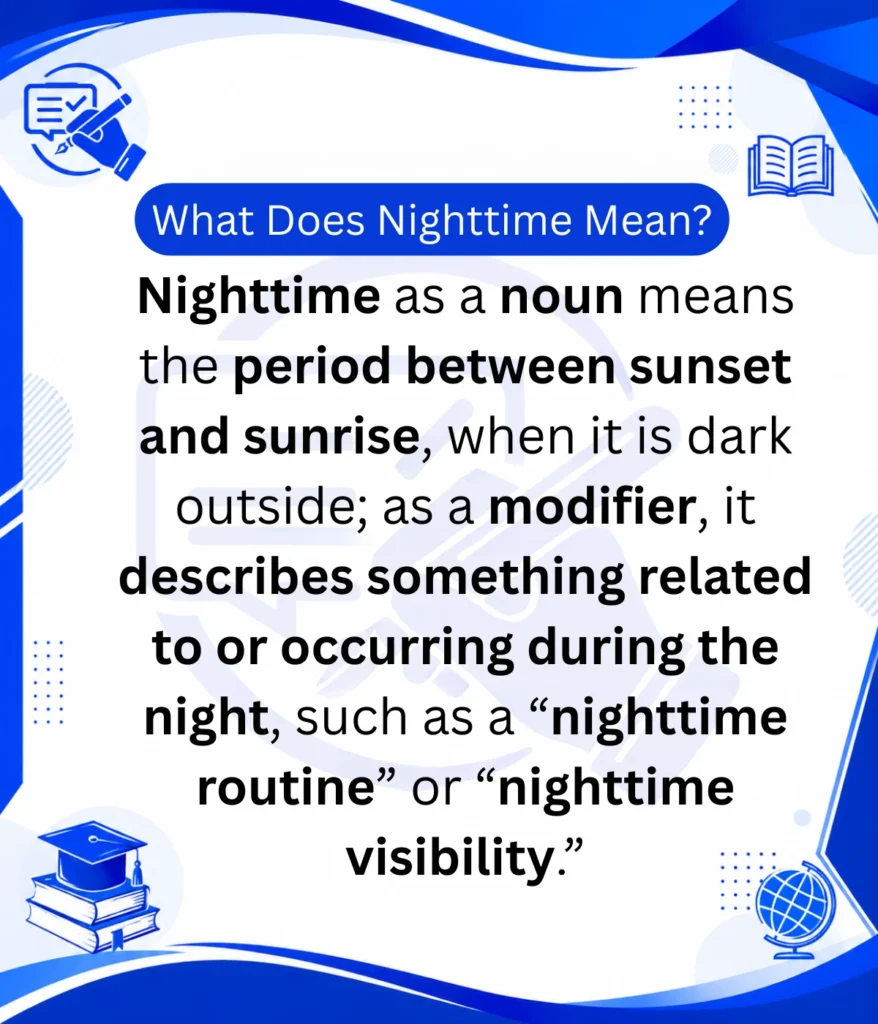
Nighttime refers to the hours between sunset and sunrise, the part of the day when it’s dark outside. Merriam-Webster has recorded this meaning consistently, and the word itself dates back roughly 600 years, so it’s far from a modern shortcut.
Nighttime as a Noun
As a noun, nighttime names the period itself.
For example: “Nighttime brings cooler air to the desert.” Here, the word stands on its own as the subject of the sentence.
You’ll see this noun form in forecasts, news stories, and casual conversation alike.
Nighttime as a Modifier (Attributive Noun)
Nighttime also works as a modifier, describing another noun. Think “nighttime routine,” “nighttime shift,” or “nighttime visibility.” Grammarians call this an attributive noun, meaning it functions almost like an adjective.
What Does Night Time Mean?
Night time, written as two words, points to the same general idea: darkness after sunset. The difference is spelling, not meaning. Both forms describe identical hours of the day.
Historically, this two-word version came first. English writers combined it into one word only after decades of frequent, repeated use.
When Night Time Is Used as Two Words
The two-word form still has one narrow, legitimate use: when “night” describes a literal, specific time slot rather than the general concept. For example: “What night time works for the meeting?” Here, “night” is simply an adjective modifying “time” as a scheduling term.
Outside that narrow case, most writers reach for the closed compound instead.
More Posts:Shown vs Showed – Meaning, Differences & Usage
Nighttime vs Night Time
The real difference between nighttime and night time comes down to compound-word evolution, not meaning. English regularly merges two frequently paired words into one, the same way “to day” became “today” and “any one” became “anyone.”
| Form | Status | Where You’ll See It |
|---|---|---|
| Nighttime | Standard, modern spelling | News, blogs, business writing, dictionaries |
| Night time | Older, informal | Casual speech, older texts, literal scheduling |
| Night-time | Hyphenated variant | Older or British-style publications |
Is Nighttime One Word or Two Words?
Nighttime is one continuous word: n-i-g-h-t-t-i-m-e, no space, no hyphen. It needs both T’s, one from “night” and one from “time,” since the compound simply joins the two words without dropping a letter.
A helpful shortcut: think of daytime. Nobody splits that into “day time” anymore, and nighttime follows the exact same pattern.
What Dictionaries and Style Guides Say
Major dictionaries, including Merriam-Webster, list nighttime as the standard headword, often flagging it as “frequently attributive” because of how often it modifies other nouns.
Widely used style guides for news and academic writing also favor the closed, one-word form for formal and everyday content alike.
That kind of agreement across reference sources is a strong signal: when in doubt, choose nighttime.
How to Use Nighttime Correctly in a Sentence
Using nighttime correctly is simple once you see it in real context. It works smoothly as a subject, an object, or a description, without ever needing extra punctuation.
Below are natural examples across a few different settings.
Nighttime Examples in Everyday Writing
- “The city feels completely different at nighttime, quieter and slower.”
- “Her nighttime routine includes tea and twenty minutes of reading.”
- “Nighttime temperatures in the desert can drop by 40 degrees.”
Nighttime Examples in Professional Writing
- “Nighttime maintenance will begin at 10:00 p.m.”
- “The report includes nighttime traffic data from the past month.”
- “Employees should flag any nighttime security concerns immediately.”
More Posts:It Worth It or It Is Worth It – Meaning, Differences & Usage
Frequently Asked Questions
Is nighttime or night time more correct?
Nighttime, written as one word, is the standard and preferred spelling in modern, published writing today.
Is night time one word or two?
It should be written as one word: nighttime. The two-word version still appears occasionally but reads as outdated in most formal writing.
Why do some people still write night time?
Older habits, inconsistent autocorrect, and exposure to older texts all keep the two-word form alive in casual writing.
Does the spelling change the meaning?
No. Both forms describe the same hours of darkness. The difference is purely spelling convention, not meaning.
Is nighttime a noun or an adjective?
It’s primarily a noun, but it frequently works as an attributive noun (functioning like an adjective) before other nouns, as in “nighttime routine.”
Is there a British vs. standard English difference?
Both varieties recognize nighttime as standard, though the hyphenated night-time appears somewhat more often in British-style publications.
Conclusion
When you’re stuck choosing between nighttime and night time, go with the one-word spelling. It’s the version dictionaries recognize, editors expect, and readers are used to seeing every day. Save the two-word form for the rare case of a literal time slot, and skip “nightime” altogether since that’s simply a typo. Lock in this one rule, and you’ll never have to second-guess the spelling again.

Hi, I’m John Henry, the voice behind Grammar Nudge. I make grammar simple and easy to understand, from basic rules to advanced writing tips. Clear explanations. Practical examples. No confusion.
Related Posts