
Pursue is the correct spelling. Persue is a common misspelling that dictionaries do not recognize.
If you want to describe chasing a goal, a career, or a dream, always write pursue.
What Does “Persue” Mean?
Persue has no meaning of its own. It is simply an incorrect version of pursue, created when writers swap the letters “u” and “e” near the start of the word.
Spell-checkers and grammar tools flag persue instantly. That alone tells you something important: this spelling has never earned a place in standard English.
Is “Persue” a Real English Word?
No. Persue does not appear in Merriam-Webster, Oxford, or Cambridge dictionaries. It exists only as a typing error, not as an accepted word.
Why “Persue” Is Considered a Misspelling
Unlike words with true regional spelling differences, persue never became an official variant anywhere. Linguists classify it strictly as a spelling error, not an alternate form.
More Posts:How-To vs. How-Tos – Meaning, Differences & Usage
What Does “Pursue” Mean?
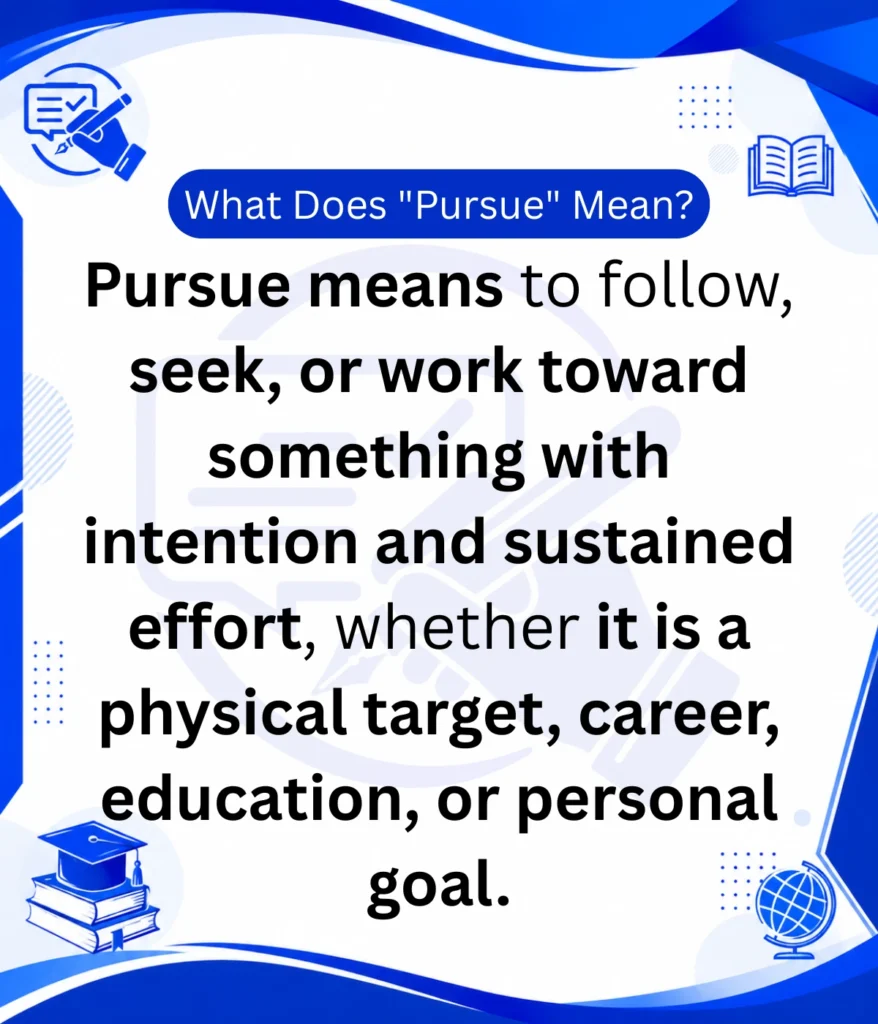
Pursue means to follow, chase, or work toward something with real effort. It can describe a physical chase or a long-term goal you’re determined to reach.
The word carries a sense of intention. You don’t pursue something casually; you move toward it with purpose and persistence.
Correct Definition of Pursue
At its core, pursue means to seek, follow, or continue working toward an outcome. Merriam-Webster defines it as “to follow in order to overtake, capture, or defeat” and “to proceed with.” Both senses show up constantly in everyday writing.
Common Contexts Where Pursue Is Used
People pursue all kinds of things, from careers to hobbies. Here are the most common contexts:
- Education – pursue a degree, pursue certification
- Career – pursue a promotion, pursue new opportunities
- Legal matters – pursue a claim, pursue legal action
- Personal goals – pursue happiness, pursue a passion
Each context uses the same core idea: sustained, deliberate effort.
Persue or Pursue: Which One Is Correct?
This isn’t really a close call. Pursue is the only spelling accepted in formal, academic, and everyday writing. Persue should never appear in a résumé, essay, or business email.
Every major style guide and dictionary agrees on this point. There’s no debate left to have.
The Correct Spelling at a Glance
Pursue always starts with “pur,” never “per.” The middle of the word carries two U sounds, even though they blend together when spoken aloud.
| Feature | Pursue | Persue |
|---|---|---|
| Correct spelling | Yes | No |
| Recognized by dictionaries | Yes | No |
| Safe for professional writing | Yes | No |
| Common in search queries | Yes | Yes (due to the typo) |
More Posts:Smelled or Smelt – Meaning, Differences & Usage
How to Use Pursue Correctly in a Sentence
Pursue is a regular verb, so its forms follow predictable rules. Once you know the four main forms, using the word correctly becomes automatic.
Pursue, Pursues, Pursued, Pursuing
| Form | Example |
|---|---|
| Pursue | I pursue my goals every day. |
| Pursues | She pursues excellence at work. |
| Pursued | He pursued a career in law. |
| Pursuing | They are pursuing new clients. |
Example Sentences With Pursue
Here are a few natural examples:
- She decided to pursue a nursing degree.
- The detective pursued every lead in the case.
- We plan to pursue this partnership next quarter.
- He’s pursuing a healthier lifestyle this year.
Notice how the word fits both literal action and long-term goals with equal ease.
Tips to Remember the Correct Spelling of Pursue
A short memory trick beats a long grammar rule. Once the correct pattern sticks, you’ll stop second-guessing yourself.
Simple Memory Tricks
Try linking pursue to the noun pursuit — nobody misspells that one. If you can spell “pursuit” correctly, you already know how “pursue” should look, since both share the same “pur” opening.
Quick Proofreading Habits
Before sending important writing, scan it once for persue. Reading your work aloud also helps, since your eyes catch spelling patterns your ear might miss.
More Posts:What Happen or What Happened – Meaning, Differences & Usage
FAQs About Persue or Pursue
Is persue a real word?
No, persue is not a real English word. It’s simply a common misspelling of pursue.
What does pursue mean?
Pursue means to follow, chase, or work steadily toward a goal, career, or ambition.
Why do people spell pursue as persue?
Because the word sounds like it starts with “per” when spoken quickly, even though it’s spelled with “pur.”
Is pursue used the same way in American and British English?
Yes, both American and British English use the identical spelling: pursue.
What is the easiest way to remember the correct spelling of pursue?
Connect it to the word pursuit — if you spell that correctly, “pursue” follows the same pattern.
What are common synonyms for pursue?
Common alternatives include chase, seek, follow, and strive for, depending on context.
Final Thoughts
The choice between persue and pursue has one clear answer: pursue is correct, and persue is a spelling mistake. Keep the “pur” pattern in mind, connect it to pursuit, and you’ll never second-guess this word again.

Hi, I’m John Henry, the voice behind Grammar Nudge. I make grammar simple and easy to understand, from basic rules to advanced writing tips. Clear explanations. Practical examples. No confusion.
Related Posts


2 thoughts on “Persue or Pursue – Meaning, Differences & Usage”