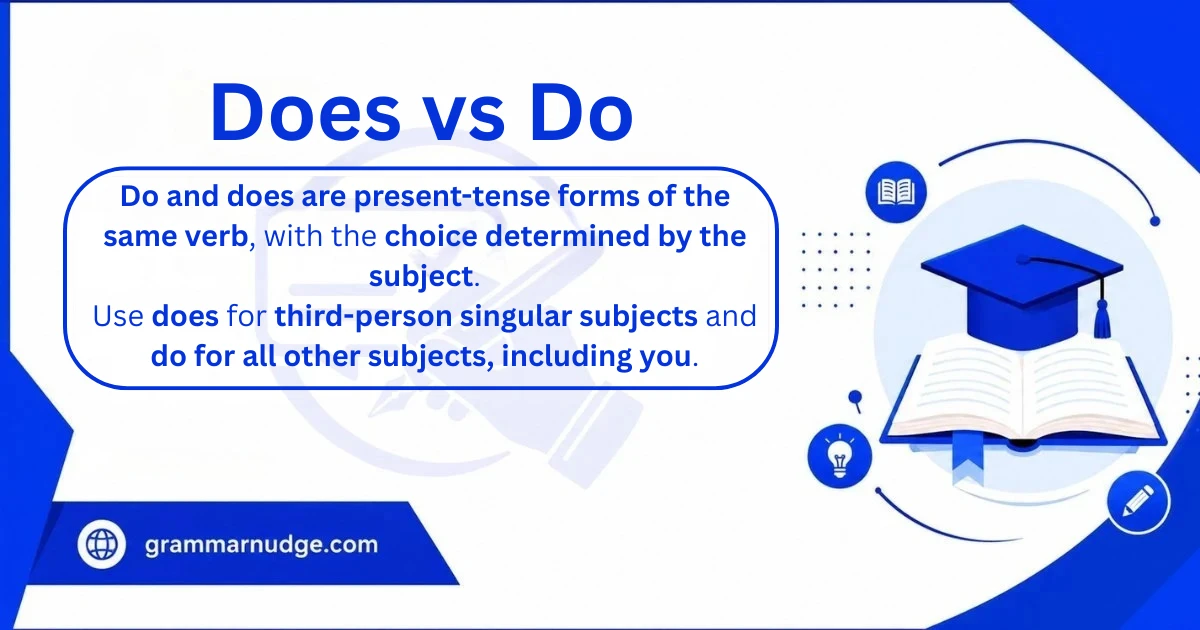
Use does with he, she, it, and any singular noun. Use do with I, you, we, they, and plural nouns.
Both words are present tense forms of the verb “do.” The subject alone decides which one fits.
What Does “Do” Mean?

Do is the base form of the verb. It works as a main verb (“I do my homework”) and as a helping verb (“Do you like tea?”).
- As a helping verb, it builds questions and negatives. It adds no meaning of its own.
Do With I, You, We, and They
These subjects always take do:
- I do my best work at night.
- You do great work.
- We do the dishes together.
- They do not agree.
Plural nouns follow the same rule. For example, “The kids do their chores.”
More Posts:Yours vs Your – Meaning, Difference, and Examples
What Does “Does” Mean?
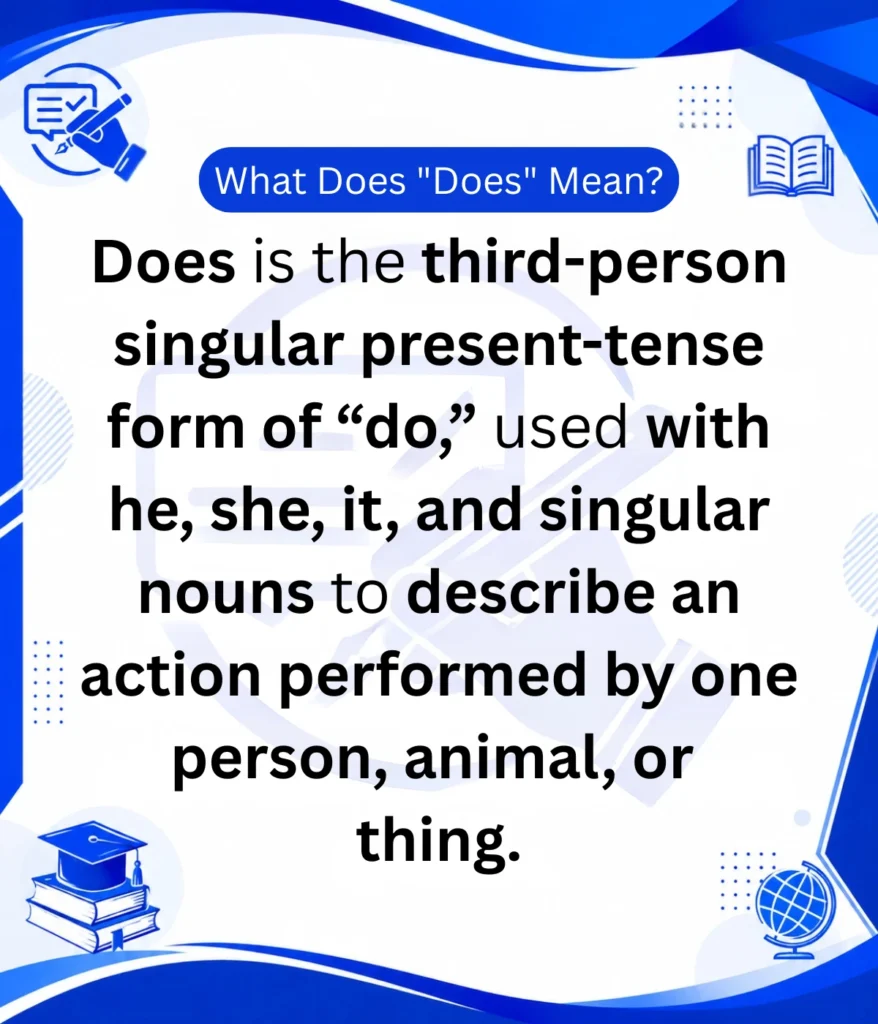
Picture a sentence like “She does yoga every morning.” That small word does is the third person singular form of “do.”
It follows the same pattern as go and goes. The verb takes an “-es” ending when the subject is one person or thing. This is basic subject-verb agreement.
Does With He, She, It, and Singular Nouns
Use does with these subjects:
- He does the shopping.
- She does her homework.
- It does the job well.
- Mark does the cooking.
- The dog does tricks.
After does, the main verb stays in its base form. So we say “Does she like it?” and never add an “s” to “like.”
More Posts:Among or Amongst – Meaning, Differences & Usage
Does vs Do
Both words mean the same thing. Only the subject changes, so the do or does choice is a quick match.
| Subject | Correct Word | Example |
|---|---|---|
| I | do | I do my part. |
| You | do | Do you know him? |
| We | do | We do it daily. |
| They | do | They do not mind. |
| He, she, it | does | She does it well. |
| Singular noun | does | Tom does his best. |
| Plural noun | do | The cats do not care. |
A simple tip helps. If you can swap in “he,” “she,” or “it,” pick does. Otherwise, pick do.
Do or Does With Everyone, Neither, and Two Names
Some subjects look plural but take does. Others look singular but take do.
- Everyone, everybody, someone, nobody, each: These count as singular, so use does.
Example:“Does everyone have a pen?” - Either and neither: These are also singular.
Example:“Neither of them does the dishes.” - Two names joined by “and”: Together they are plural, so use do.
Example:“Tom and Mary do the cooking.” - Two subjects joined by “or” or “nor”: Match the verb to the subject closest to it.
Example:“Either the coach or the players do the setup.”
In a question with a long subject, find the main noun before you choose. In “Does the list of rules apply to us?”, the subject is “list,” not “rules.”
More Posts:Dialog or Dialogue – Meaning, Differences & Usage
Do or Does in Questions and Negatives
In questions, the helping verb comes first. We say “Do you know?” and “Does he know?”
In negatives, we use don’t (do not) and doesn’t (does not). For example, “I don’t know” and “She doesn’t know.” Commands use only do, as in “Do your homework.”
Does vs Do FAQs
Is it “does he” or “do he”?
It is does he. The subject “he” is third person singular, so it takes does.
Is it “do they” or “does they”?
It is do they. “They” is plural, so do is always the right choice.
Can I use “does” with “you”?
No. “You” always takes do, even when you mean just one person. For example, “Do you want coffee?”
Does the main verb take an “s” after “does”?
No. After does, the main verb stays in its base form. We say “Does she work here?”
Can “do” and “does” be main verbs?
Yes. In “I do the laundry” and “He does the laundry,” they are main verbs. In “Do you like it?” they are helping verbs.
Conclusion
The does vs do choice comes down to one thing: the subject. Use does with he, she, it, and singular nouns, and use do with all other subjects. Check the subject first, and the right word follows.

Hi, I’m John Henry, the voice behind Grammar Nudge. I make grammar simple and easy to understand, from basic rules to advanced writing tips. Clear explanations. Practical examples. No confusion.
Related Posts