
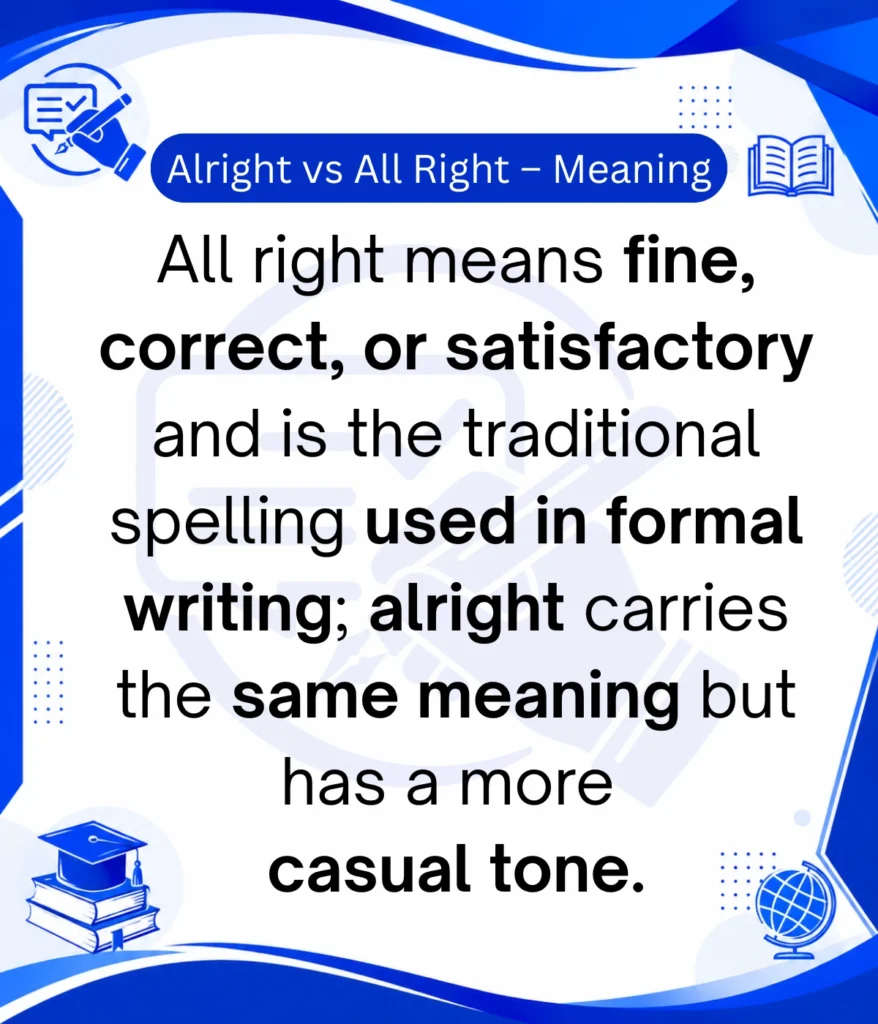
Alright and all right mean the same thing, but only one is considered correct in formal writing. All right is the standard, accepted spelling for schoolwork, business, and professional writing. Alright is the casual, shortened version used in texting and everyday talk.
Knowing when to use each one makes your writing look polished and confident.
Alright vs All Right – Meaning
What Does All Right Mean?
All right is the traditional two-word spelling that has been used for centuries. It works as an adjective or adverb and usually means something is satisfactory, correct, or fine.
This is the version taught in schools and used in newspapers, books, and official documents. If you want your writing to look clean and professional, all right is the safer choice.
All Right in a Sentence
- “The exam went all right, though a few questions were tricky.”
- “Is everything all right at home?”
- “The manager said the report was all right to submit.”
What Does Alright Mean?
Alright is the modern, one-word spelling of the same phrase. It carries the exact same meaning but feels more relaxed and conversational.
You’ll see alright in text messages, song lyrics, and casual dialogue. It’s not wrong—it’s just informal, and many editors still avoid it in polished writing.
Alright in a Sentence
- “Alright, let’s get started.”
- “I’m alright, just a little tired.”
- “She said the trip was alright.”
More Posts:Astronomy vs Astrology – Meaning, Differences & Usage
Alright vs All Right – Key Differences
The real difference between alright and all right isn’t meaning—it’s formality. Both phrases express the same idea of being fine, correct, or acceptable.
| Feature | All Right | Alright |
|---|---|---|
| Spelling | Two words | One word |
| Formality | Formal, traditional | Informal, casual |
| Best for | Essays, emails, reports | Texts, dialogue, social media |
| Dictionary status | Fully accepted | Accepted informally |
When to Use All Right vs Alright
Choosing between alright and all right comes down to your audience and context. Formal writing calls for the traditional spelling, while casual writing gives you room to relax.
Use all right when writing:
- School essays or research papers
- Business emails or reports
- Resumes and cover letters
- News articles or official content
Use alright when writing:
- Text messages or DMs
- Casual emails to friends
- Dialogue in a story or script
- Social media captions
What’s the safest choice? If you’re ever unsure, go with all right. It works everywhere and never looks out of place.
More Posts:Recurring vs Reoccurring – Meaning, Differences & Usage
Common Mistakes With Alright or All Right
The biggest mistake writers make is spelling it “allright”—with a double L as one word. This spelling doesn’t exist in any dictionary and should always be avoided.
Another common slip is overcorrecting. Some writers force all right into casual dialogue where alright would sound more natural, making the writing feel stiff.
| Wrong | Correct |
|---|---|
| He did allright on the test. | He did all right on the test. |
| “Are you all right?” (in a casual text) | “You alright?” |
More Posts:Smelled or Smelt – Meaning, Differences & Usage
FAQs About Alright vs All Right
Is alright a real word?
Yes, alright is a real, recognized word listed in modern dictionaries, though it’s still treated as informal compared to all right.
Is it “you’re alright” or “you’re all right”?
Both work. “You’re all right” fits formal writing, while “you’re alright” sounds natural in everyday conversation.
Why do style guides prefer all right?
Most style guides, including AP and Chicago, list all right as the standard spelling because it’s been the accepted form for over a century.
Does alright mean something different from all right?
No, the meaning is identical. The only difference is formality, not definition.
Is alright acceptable in everyday writing?
Yes, alright is widely accepted in casual writing. In British usage, it also appears slightly more often in informal print than it does elsewhere, but all right remains the standard formal choice everywhere.
Final Verdict on Alright vs All Right
The choice between alright and all right isn’t about right or wrong—it’s about context. Use all right for anything formal, and let alright handle your casual, everyday writing.
When in doubt, all right is always the safe bet.

Hi, I’m John Henry, the voice behind Grammar Nudge. I make grammar simple and easy to understand, from basic rules to advanced writing tips. Clear explanations. Practical examples. No confusion.
Related Posts