Begin vs began vs begun comes down to tense. Begin is the present form, began is the simple past tense, and begun is the past participle. Use began on its own. Use begun only with a helping verb like has, have, or had.
This guide shows each form in simple steps, with clear examples you can copy.
Begin vs Began vs Begun
Three Forms of One Irregular Verb
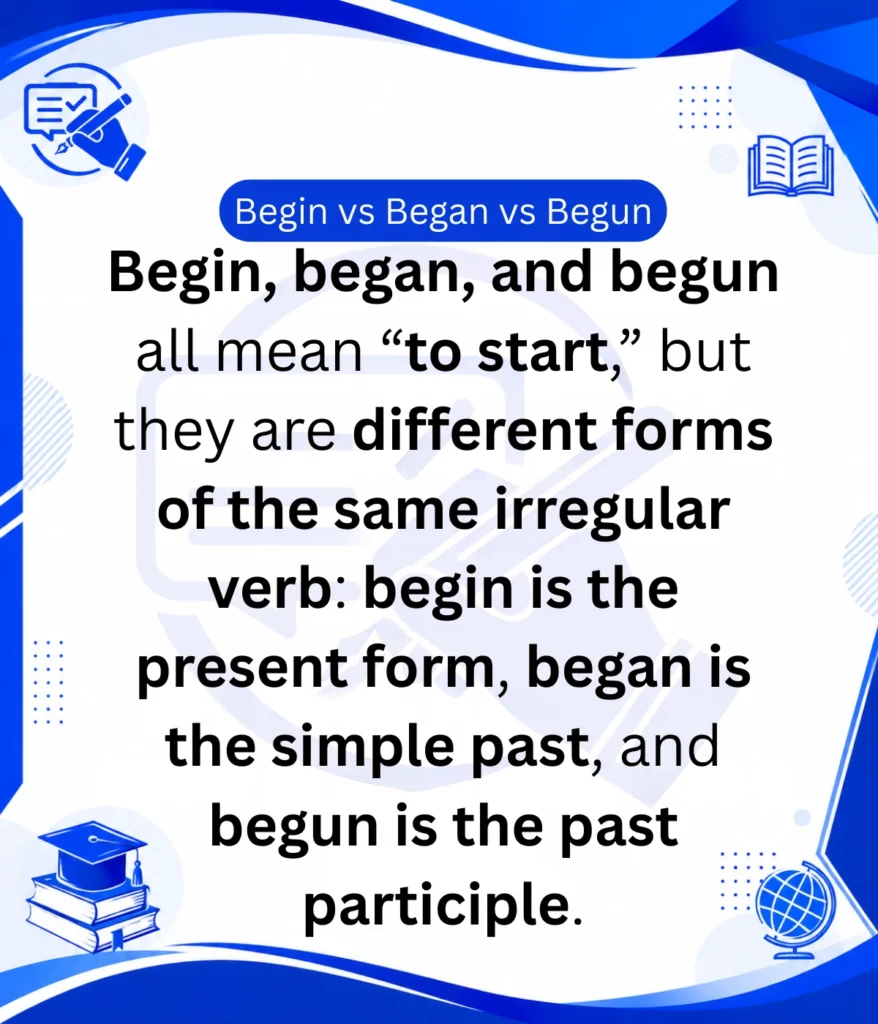
Begin means “to start.” It is an irregular verb, so it does not add -ed to form the past. Instead, the vowel changes: begin, began, begun.
Many verbs follow this pattern, such as sing, sang, sung and drink, drank, drunk.
The One-Line Rule
Look for a helping verb before the word. If you see has, have, or had, use begun. If you don’t, use began.
- Begin: present or future (We begin today)
- Began: finished past action (We began yesterday)
- Begun: with a helping verb (We have begun)
More Posts:Will vs Would – Meaning, Differences & Usage
What Does Begin Mean?
Begin as the Present Tense
Begin means to start or to take the first step. We use it for actions that happen now or happen regularly.
The class begins at 9 a.m. I begin my workday with a short walk. Notice that begin takes an -s with he, she, or it: begins.
Begin in the Future Tense
To talk about the future, add will before begin. The verb itself stays the same.
The game will begin in ten minutes. School will begin in August. You can also use it after words like can, should, and must.
When to Use Began
Began as the Simple Past Tense
Began is the simple past tense of begin. It shows an action that started at a clear time in the past.
It never takes a helping verb. That means “had began” and “has began” are always wrong.
Began Example Sentences
Words like yesterday, last week, or in 1990 are strong clues that began is the right choice.
- We began our hike at sunrise.
- It began to rain after lunch.
- She began learning guitar when she was ten.
When to Use Begun
Begun as the Past Participle
Begun is the past participle of begin. It cannot stand alone, so it always needs a helping verb or a form of “be.”
Writers often say “they begun” by mistake. The fix is simple: add a helper (they have begun) or switch to began (they began).
Begun in Perfect Tenses and Passive Voice
Begun builds the perfect tenses. Each one pairs begun with a different helping verb.
- Present perfect: The meeting has begun.
- Past perfect: The show had begun before we sat down.
- Future perfect: By noon, we will have begun the test.
- Passive voice: The project was begun last year.
Began vs Begun
| Form | Tense | Helping Verb | Example |
|---|---|---|---|
| Began | Simple past | Not needed | The film began at 7. |
| Begun | Past participle | Required | The film has begun. |
More Posts:Used To vs Use To – Meaning, Differences & Usage
FAQs About Begin vs Began vs Begun
Is it “has begun” or “has began”?
The correct phrase is has begun. Began never follows has, have, or had.
Is “they begun” or “they have begun” correct?
They have begun is correct. Begun needs a helping verb, so “they begun” is wrong.
Is began the past tense of begin?
Yes. Began is the simple past tense of begin, and it needs no helping verb.
Is begin an irregular verb?
Yes. Begin is irregular because its past forms (began, begun) do not end in -ed.
Is there a difference between American and British English for these forms?
No. Both use the same three forms: begin, began, and begun.
Conclusion
Keep it simple: begin is for now, began is for finished past actions, and begun always travels with a helping verb. At GrammarThat.com, we find the “look for has, have, or had” test fixes most mix-ups in seconds.

Hi, I’m John Henry, the voice behind Grammar Nudge. I make grammar simple and easy to understand, from basic rules to advanced writing tips. Clear explanations. Practical examples. No confusion.
Related Posts