Emasculate is the correct word for a loss of strength, authority, confidence, or masculinity.Demasculate is not a standard English word, so use emasculate in formal and everyday writing.
What Does “Emasculate” Mean?
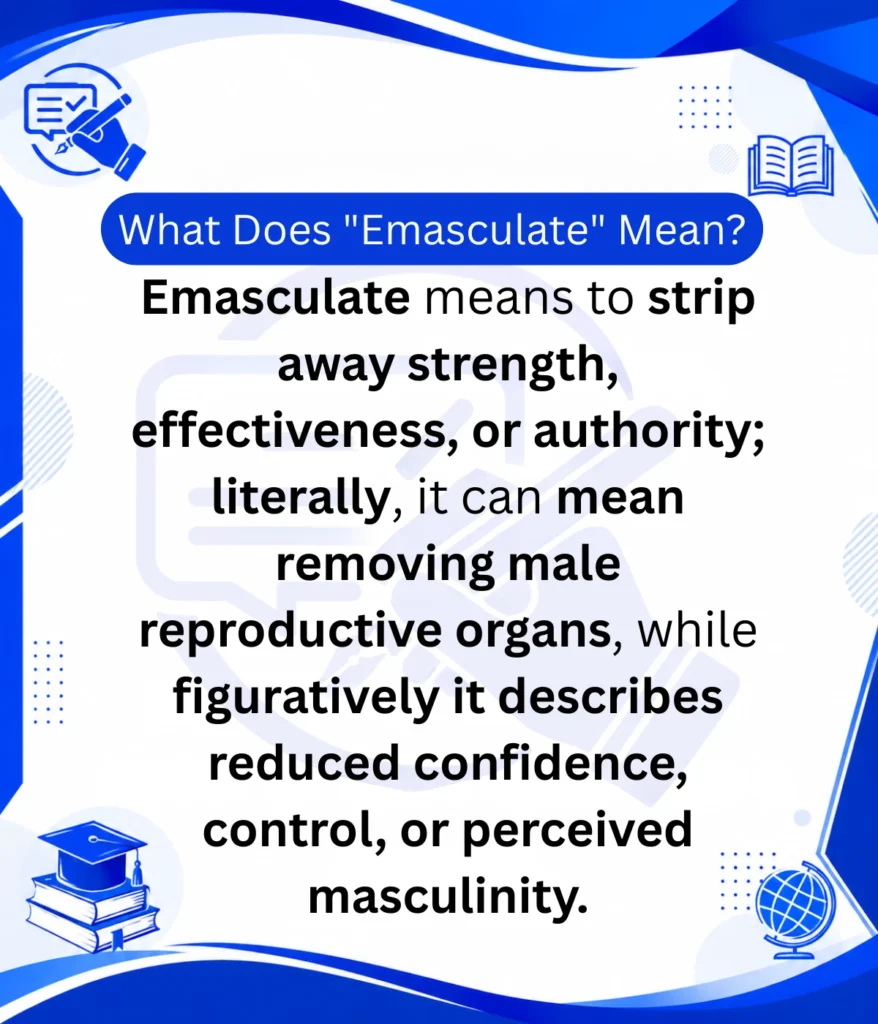
At its core, emasculate means to strip away strength or effectiveness. It can describe a person, a policy, or even an entire organization.
You’ll see it used when authority gets reduced. “The new law emasculated the agency’s power” is a typical example.
Latin Origin of Emasculate
The word traces back to the Latin term emasculare. This combines e- (“out” or “away”) with masculus (“male”).
English writers borrowed the word in the 1600s. It first appeared in medical and farming texts before spreading into everyday language.
More Posts:Goodmorning or Good Morning – Meaning, Differences & Usage
Literal and Figurative Meaning of Emasculate
The literal meaning refers to removing male reproductive organs. You’ll find this usage in veterinary and medical writing.
The figurative meaning is far more common today. It describes a loss of confidence, control, or perceived masculinity.
What Does “Demasculate” Mean?
No. Demasculate has zero listing in Merriam-Webster, Oxford, or Cambridge dictionaries.
Spell-checkers flag it instantly. Published articles and academic papers never use this form.
Why Demasculate Isn’t in the Dictionary
The prefix logic doesn’t hold up. Emasculate already carries the meaning of “removal,” so adding “de-” creates unnecessary repetition.
There’s also no root word “masculate” to attach a prefix to in the first place.
Where Demasculate Comes From
Social media and casual writing likely popularized it. Autocorrect errors, memes, and quick online content spread the word without checking its accuracy.
Over time, repeated exposure made it feel familiar, even though it never earned dictionary recognition.
Emasculate vs Demasculate
The two words aren’t interchangeable. Only one holds any linguistic or dictionary support.
| Feature | Emasculate | Demasculate |
|---|---|---|
| Dictionary status | Recognized | Not recognized |
| Origin | Latin emasculare | No formal origin |
| Literal meaning | Yes | None |
| Figurative meaning | Yes | None |
| Safe for formal writing | Yes | No |
Which Word Should You Use?
Always choose emasculate. It’s accepted in academic, professional, and everyday writing.
Demasculate should be avoided entirely, even in casual text or social posts, if you want your writing to read as accurate.
More Posts:Anyone Has or Anyone Have – Meaning, Differences & Usage
How to Use Emasculate in a Sentence
Emasculate works as a verb across personal, professional, and cultural contexts. It typically appears when describing a loss of power or confidence.
Choosing the right sentence structure keeps the tone clear and precise.
Example Sentences
- “Budget cuts emasculated the department’s ability to function.”
- “He felt emasculated after losing decision-making authority.”
- “Critics said the edits emasculated the original argument.”
Emasculate in Professional Writing
In business or academic writing, emasculate describes weakened authority or reduced effectiveness. It fits political analysis, workplace commentary, and leadership discussions.
Use it carefully, since the word can carry strong emotional weight when aimed at a specific person.
Alternatives to Emasculate
Sometimes a neutral alternative communicates the same idea without the emotional charge. This works well in sensitive or formal writing.
Swapping in a synonym can also help avoid repeating the same word too often.
Synonyms for Emasculate
Weaken, undermine, diminish, reduce, and erode all serve as close substitutes depending on context.
When to Use a Neutral Alternative
Choose a softer word when writing about a specific person’s feelings. Terms like “diminished his confidence” often read as more respectful than “emasculated him.”
FAQs About Emasculate vs Demasculate
Is demasculate a real word?
No. Demasculate isn’t recognized by any major English dictionary and is considered nonstandard.
What does emasculate mean?
It means to weaken someone’s power, confidence, or masculinity, either literally or figuratively.
Which word should I use in professional writing?
Always use emasculate. It’s the only dictionary-approved, professionally accepted form.
Why is demasculate considered incorrect?
Because emasculate already carries the meaning of removal, adding “de-” creates a redundant, unrecognized word.
Does emasculate only apply to men?
No. It’s regularly used for organizations, policies, and ideas that lose strength or effectiveness. Both standard English varieties, including British English, use only “emasculate” — there’s no spelling variation between them.

Hi, I’m John Henry, the voice behind Grammar Nudge. I make grammar simple and easy to understand, from basic rules to advanced writing tips. Clear explanations. Practical examples. No confusion.
Related Posts