Good morning is always the correct spelling. It is written as two separate words, never as one. “Goodmorning” is a common typing mistake, not a real word in any dictionary.
Still, this tiny mix-up trips up a lot of people every single day. You type fast, autocorrect doesn’t flag it, and suddenly you’re not sure if it should be one word or two.
Good Morning It’s Always Two Words
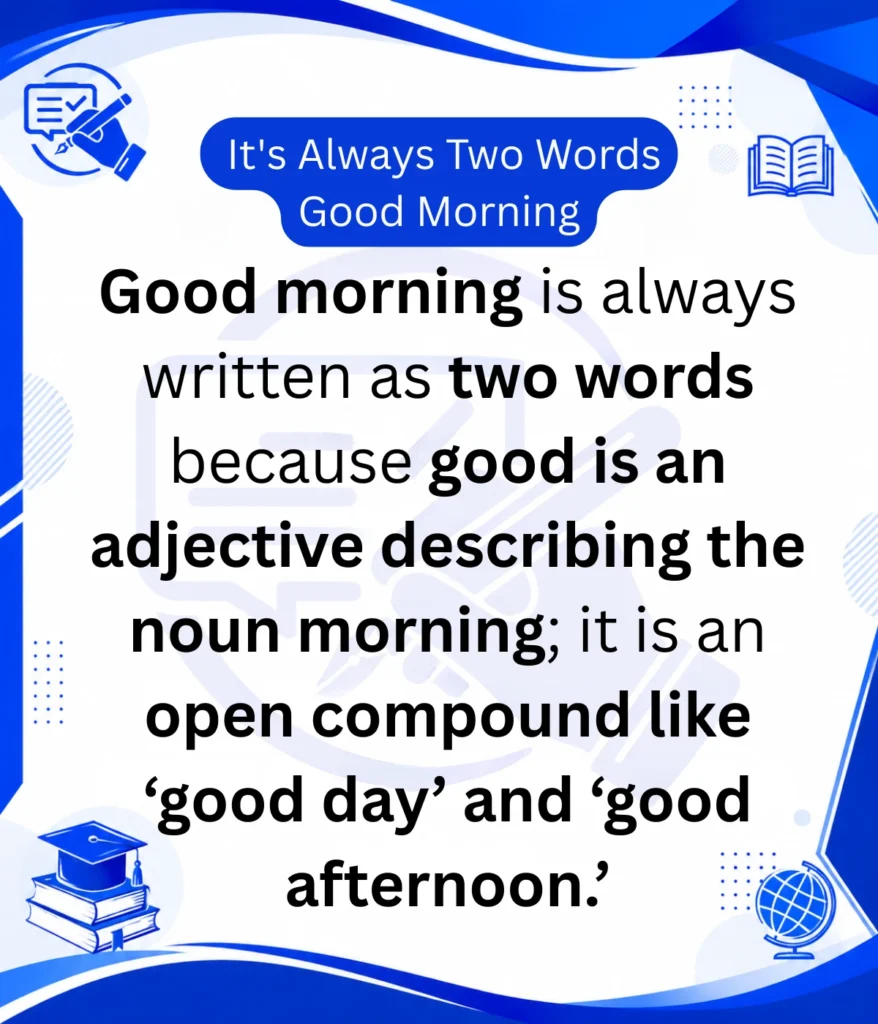
Good morning is built from an adjective (“good”) plus a noun (“morning”). The word “good” simply describes the quality of the morning, the same way it works in “good day” or “good afternoon.” English keeps adjective-noun pairs like this separated by a space.
This pattern isn’t new. It traces back to Middle English, where greetings worked like short blessings, such as “god morwen,” roughly meaning “may you have a good morning.” That two-part structure never fused into a single word, unlike some other everyday terms.
More Posts:Anyone Has or Anyone Have – Meaning, Differences & Usage
The History Behind Why It Never Merged
Compare this to goodbye, which came from the phrase “God be with ye” and slowly fused into one word through centuries of casual, fast speech.
Good morning never went through that same merging process. It kept its original two-word grammar structure, and dictionaries have never listed it any other way.
Linguists call phrases like this open compounds: two separate words that function together as one idea, without ever physically joining. “Ice cream” and “high school” work the same way.
Goodmorning
Goodmorning isn’t a misspelling of some rare word. It simply doesn’t exist as a standard English term. No major dictionary, style guide, or grammar resource lists it as an accepted form. It only shows up as a rushed shortcut in casual writing.
Why People Write It as One Word
A few habits explain why this mistake spreads so fast:
- Speed typing — fingers move faster than the brain checks spelling
- Pattern confusion — writers see “goodnight” as one word and assume “goodmorning” follows suit
- Weak autocorrect — some keyboards simply don’t catch the error
- Texting culture — informal chats skip careful spelling in favor of speed
Where You’ll Still See It
You’ll spot goodmorning mostly in texts, quick social media captions, and hashtags like #goodmorning. It’s tolerated there because branding and speed matter more than strict grammar. Outside of that casual space, it should be avoided completely, especially in anything professional.
Goodmorning vs Good Morning
| Feature | Good Morning | Goodmorning |
|---|---|---|
| Word count | Two words | One word |
| Grammar status | Standard, dictionary-approved | Not a recognized word |
| Best used in | Emails, essays, speech, texts | Nowhere formal |
| Dictionary listing | Yes | No |
More Posts:Dammit vs Damn It – Meaning, Differences & Usage
How to Use Good Morning Correctly in Real Writing
Good Morning in Professional Emails
Always keep it as two words in business communication. “Good morning, Ms. Patel, I wanted to follow up on our call” reads as clean and polished. A merged spelling here can make an otherwise strong message look careless.
Good Morning in Texts, DMs and Social Media Captions
Casual doesn’t mean careless. “Good morning! Coffee later?” still looks and reads better than the squished version, even in a quick text to a friend. On social captions, some brands stylize #goodmorning intentionally, but that’s a design choice, not a grammar rule.
Capitalization and Punctuation Rules
Only capitalize the first letter when it starts a sentence: “Good morning, everyone.” Mid-sentence, keep it lowercase: “She always says good morning to her neighbors.” Add a comma before a name that follows: “Good morning, David.”
Fresh Ways to Say Good Morning
Repeating the same greeting daily can feel flat. Mixing it up keeps your messages, captions, and emails feeling genuine.
Formal alternatives for emails and business messages:
- “I hope this message finds you well this morning”
- “Wishing you a productive start to your day”
- “Hope your morning is off to a great start”
Casual alternatives for friends and family:
- “Morning, sunshine!”
- “Rise and shine!”
- “Hope you woke up on the right side of the bed”
These options keep your writing lively while still respecting the correct spelling of good morning whenever you use the standard version.
FAQs About Goodmorning or Good Morning
Is it goodmorning or good morning?
It’s always good morning, written as two separate words. “Goodmorning” is not a recognized word in standard English.
Is goodmorning one word?
No. Goodmorning is a common misspelling, not an accepted one-word term in any dictionary.
Do you capitalize good morning in a sentence?
Only capitalize the first word when it starts a sentence. Mid-sentence, write it in lowercase.
Is good morning spelled differently in British English?
No, real difference exists here. Good morning is spelled the same way in both British and standard American writing, unlike words such as “colour” versus “color.”
Can I use goodmorning in a text message?
You can, but it’s still technically incorrect. Good morning remains the safer, correct choice even in casual texts.
Is Good Morning correct when starting an email?
Yes. “Good morning” works well as a professional email opener, followed by a comma and the recipient’s name.
Conclusion
Good morning is always two words, no exceptions and no shortcuts that hold up in real writing. Whether you’re sending a work email, texting a friend, or writing a quick caption, sticking with the correct spelling makes your message look sharper and more intentional. Keep the adjective-noun rule in mind, and you’ll never second-guess this greeting again.

Hi, I’m John Henry, the voice behind Grammar Nudge. I make grammar simple and easy to understand, from basic rules to advanced writing tips. Clear explanations. Practical examples. No confusion.
Related Posts