You can spell it dammit or damn it, and both are correct. The real difference comes down to grammar and tone, not right versus wrong. “Dammit” works as one punchy interjection, while “damn it” is a two-word phrase with a verb and an object.
Once you see how each one works, picking the right spelling becomes second nature.
What Does “Dammit” Mean?
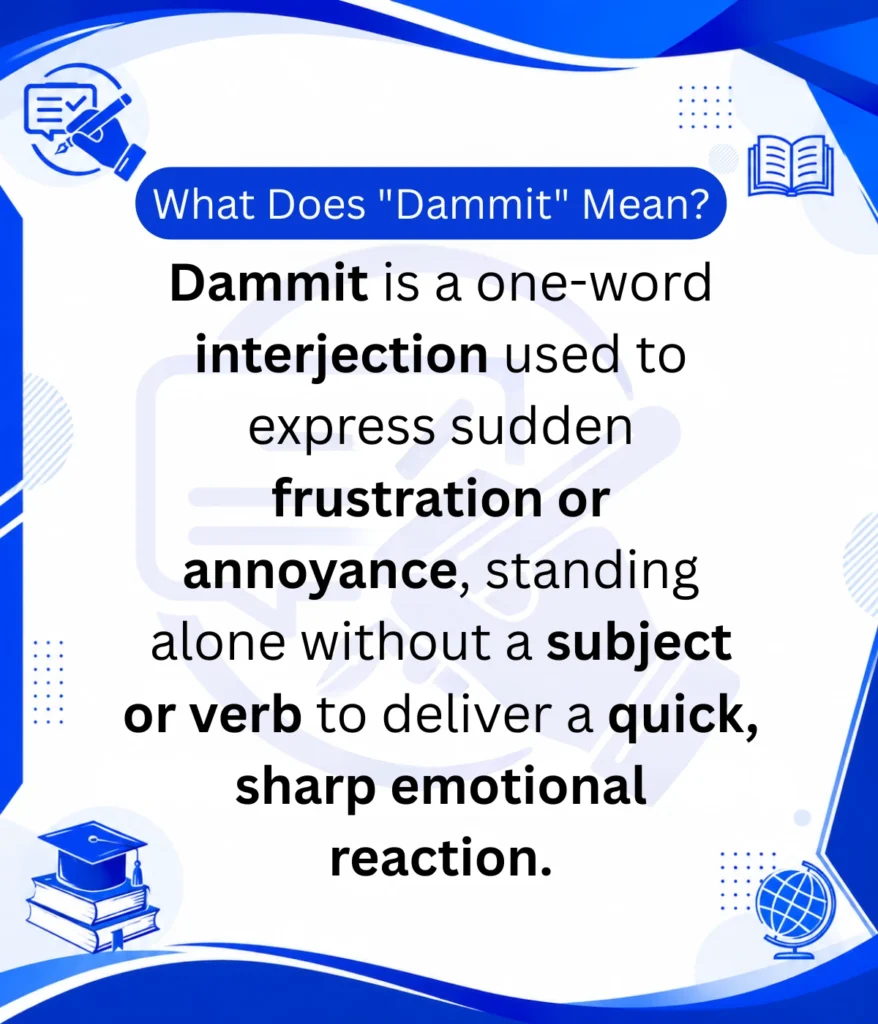
“Dammit” is a single word. It acts like other short interjections such as “ugh” or “yikes.” You use it to release frustration fast, without slowing down to form a full phrase.
Because it’s one compact burst, it reads faster on the page too. That’s why you see it so often in dialogue, texts, and casual writing.
“Dammit” as a One-Word Interjection
An interjection is a word that stands alone to express emotion. “Dammit” fits that role perfectly. It doesn’t need a subject or a verb attached to make sense — it just fires off on its own.
How to Use “Dammit” in a Sentence
Drop “dammit” in wherever a sharp burst of frustration fits naturally:
- “Dammit, I locked my keys in the car.”
- “Dammit, that meeting ran long.”
- “I’m serious, dammit.”
More Posts:Lunchtime vs Lunch Time – Meaning, Differences & Usage
What Does “Damn It” Mean?
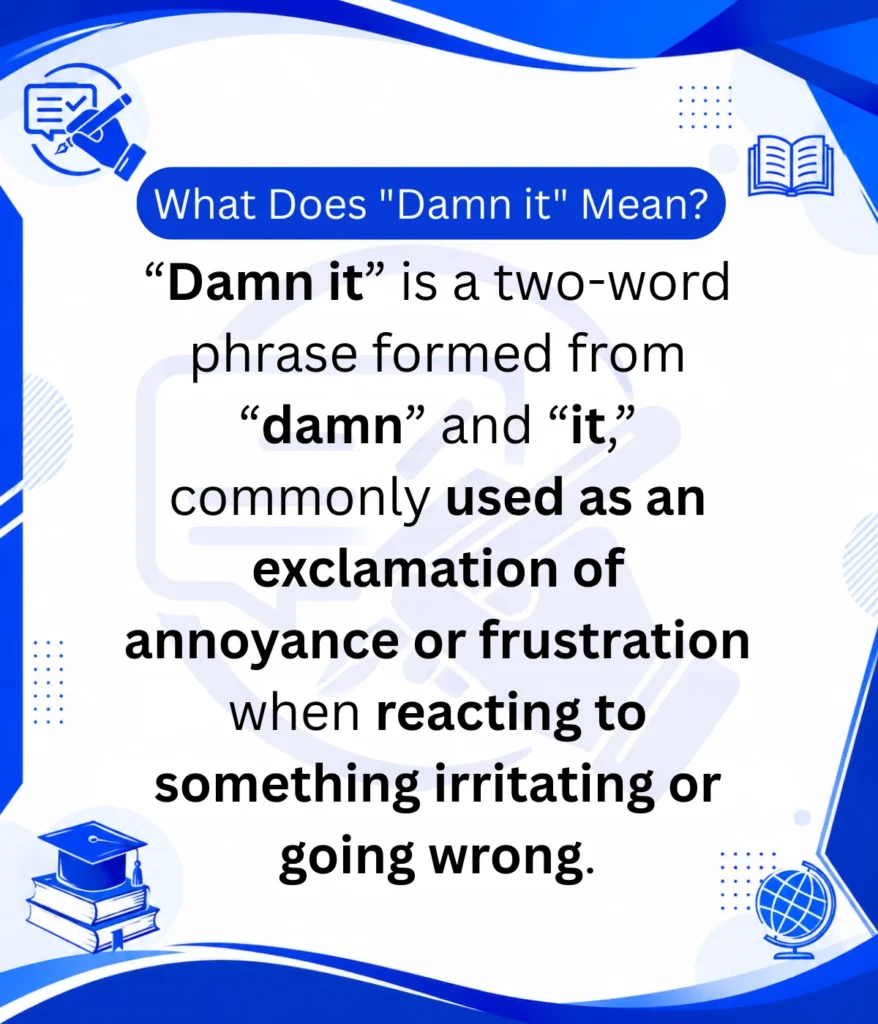
“Damn it” is a phrase, not a single word. It’s built from the verb “damn” plus the pronoun “it.” Structurally, it still carries a faint trace of its original meaning: to condemn something.
In everyday use, that original meaning has faded almost completely. Today, “damn it” mostly just signals annoyance, same as “dammit” does.
“Damn It” as a Two-Word Phrase
Because “damn it” keeps its two-word structure, it reads with a small pause built in. That tiny gap between “damn” and “it” gives the phrase a slightly more deliberate, controlled feel compared to the one-word version.
How to Use “Damn It” in a Sentence
Try “damn it” when you want that fuller, more grammatical rhythm:
- “Damn it, stop ignoring the instructions.”
- “Damn it all, I’m done arguing about this.”
- “Damn it, why won’t this printer work?”
Dammit vs Damn It – Which Spelling Should You Use?
| Feature | Dammit | Damn It |
|---|---|---|
| Word count | One word | Two words |
| Function | Interjection | Verb + pronoun phrase |
| Feel | Quick, sharp | Slightly slower, deliberate |
| Best for | Dialogue, texting, casual writing | Formal-leaning casual writing |
What About “Damnit”?
“Damnit” is an informal variant of “dammit” that you may see in casual writing, texting, and dialogue. “Dammit” is the more common one-word spelling, while “damn it” remains the standard two-word form.
For polished writing, use “dammit” or “damn it” rather than “damnit.”
Grammar Difference Between Dammit and Damn It
“Dammit” functions as a standalone exclamation. “Damn it” functions as a mini clause, even in casual speech. That structural gap is the whole difference — not spelling preference, not correctness.
Tone and Emotional Weight of Each Spelling
Say both out loud. “Dammit” comes out in one breath. “Damn it” has a beat between the two words. Writers often pick one over the other just to control how fast or slow a line of dialogue feels.
Yes — I’d make the added section much tighter and more direct:
More Posts:Lunchtime vs Lunch Time – Meaning, Differences & Usage
Is Dammit or Damn It Considered a Swear Word?
Yes, both count as mild profanity. They sit far below stronger curse words on the offensiveness scale, which is why you’ll hear them in places that ban harsher language — daytime TV, PG-13 movies, casual workplace chat.
Context still matters. A word being “mild” doesn’t make it appropriate everywhere.
Where Does “Dammit” Come From?
The word damn traces back to the Latin damnare, meaning “to condemn.” For centuries, “damn it” carried real religious weight — it literally meant sending something to punishment.
Over time, that heavy meaning wore down. By the 1900s, “damn it” had become a casual outburst rather than an actual condemnation.
The Root Meaning of “Damn”
Damn belongs to a small group of English words ending in a silent “n” — think autumn, column, and hymn. All of them come from Latin originals where that “n” was fully pronounced.
How “Dammit” Became a Phonetic Spelling
Nobody pronounces the “n” in “damn it” when they say it fast. Writers eventually dropped it from the spelling too, the same way “going to” became “gonna” and “want to” became “wanna.” “Dammit” simply matches how the phrase actually sounds.
FAQs About Dammit vs Damn It
Is “dammit” one word or two?
“Dammit” is always spelled as one word. “Damn it” is the two-word version of the same phrase.
Is it OK to use “dammit” in writing?
Yes, in casual writing, dialogue, and texting. Avoid it in formal or professional documents.
What’s the difference between “dammit” and “goddammit”?
“Goddammit” adds “God” to the phrase, making it noticeably more offensive, especially in religious contexts.
Do people say “dammit” or “damn it” more often?
Usage varies by region — some prefer “dammit,” others lean toward “damn it,” but both are widely understood everywhere.
Conclusion
Both spellings say the same thing. “Dammit” grabs attention fast as one sharp word. “Damn it” keeps its two-word structure for a steadier beat. Use whichever one matches the rhythm your sentence needs.

Hi, I’m John Henry, the voice behind Grammar Nudge. I make grammar simple and easy to understand, from basic rules to advanced writing tips. Clear explanations. Practical examples. No confusion.
Related Posts