Die is singular and means one small cube used in games. Dice is plural and means two or more of those cubes.
But both words carry extra meanings — from cooking to manufacturing to everyday speech — and this guide covers all of it clearly.
What Does Die Mean?
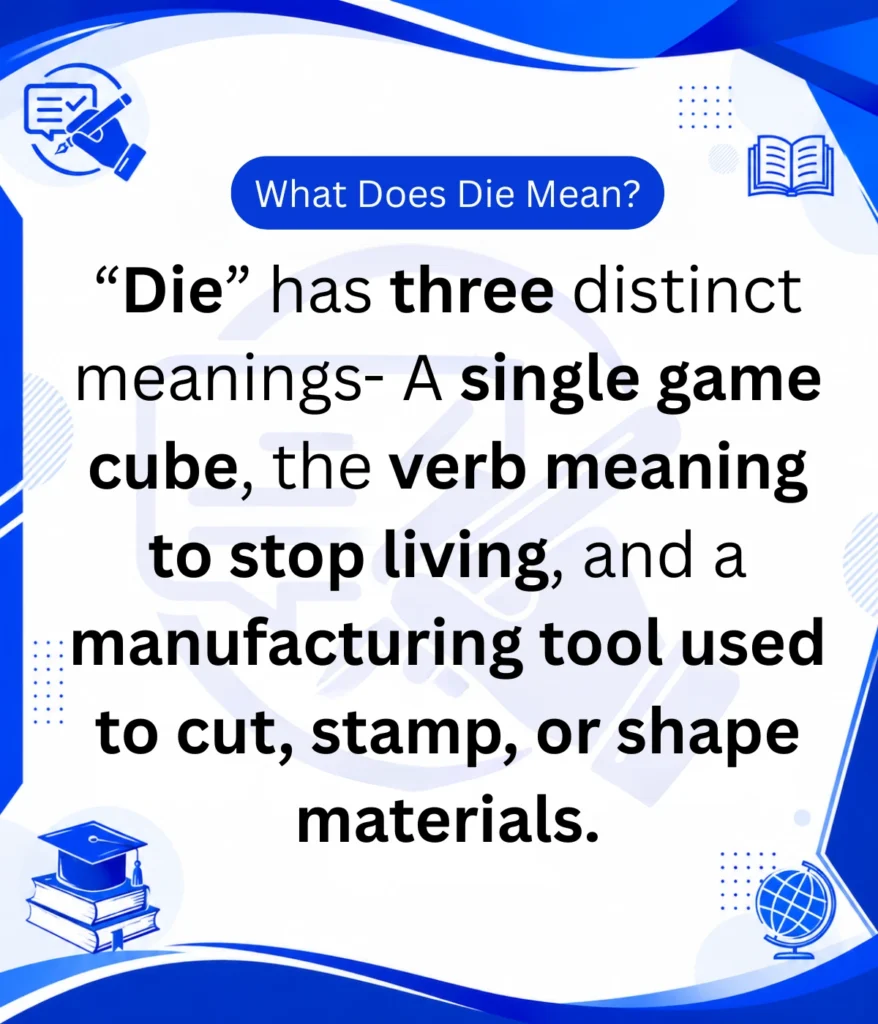
Die as a Noun (One Game Cube)
A die is a single small cube marked with numbers or dots, used to add chance to a game. Board games like Clue use just one. Games like Yahtzee or Dungeons & Dragons often use several dice at once, but each individual piece is still a die.
Die as a Verb (To Stop Living)
Die also means to stop living. This applies to people, plants, animals, and even trends or ideas. Example: “Old habits die hard.” Its past tense is died, and its present participle is dying.
Die as a Noun (Manufacturing Tool)
In factories, a die is a hardened tool used to cut, stamp, or shape metal and plastic. Coins, car parts, and plastic molds are all formed with a die. This meaning has nothing to do with games or death — it’s purely industrial.
More Posts:Unorganized vs Disorganized – Meaning, Differences & Usage
What Does Dice Mean?
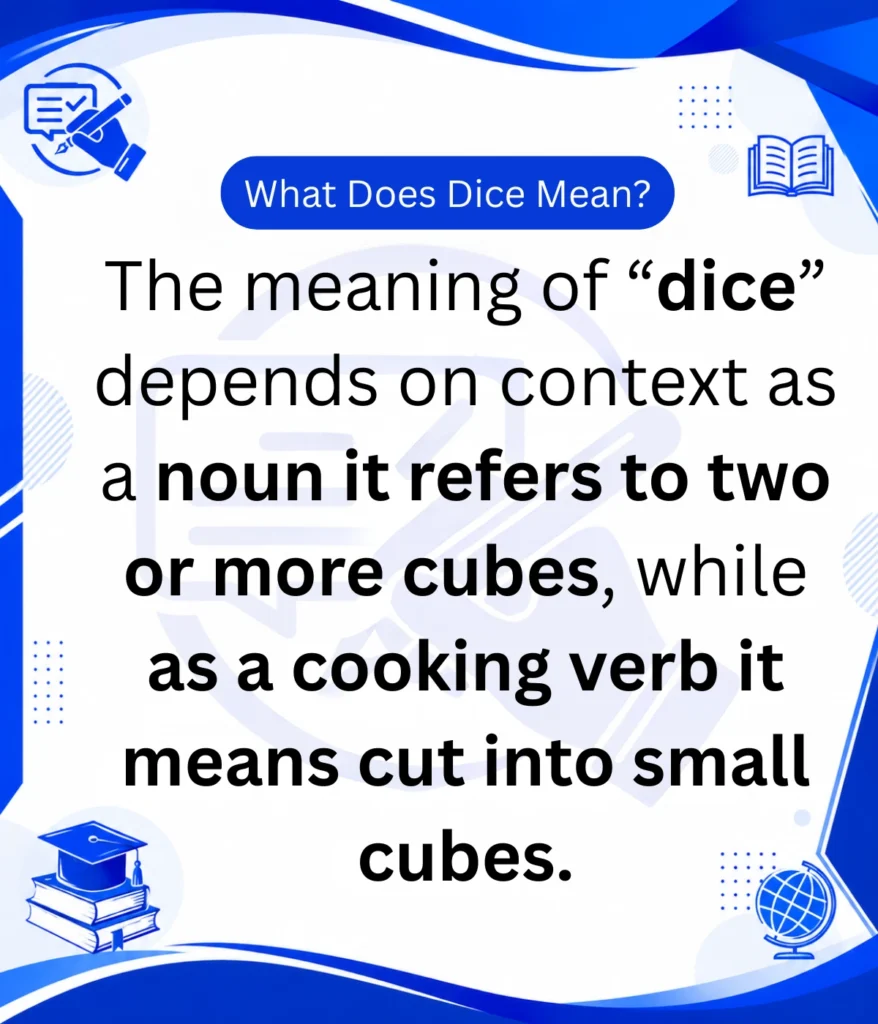
Dice as a Noun (Two or More Cubes)
Traditionally, dice is simply the plural of die. One cube is a die; two or more are dice. Casual speech often bends this rule, but the traditional distinction still holds in careful writing.
Dice as a Verb (Cooking)
In the kitchen, dice means to cut food into small, even cubes. Recipes commonly say “dice the onions” or “dice the tomatoes.” This creates uniform pieces that cook evenly — different from chopping or mincing, which produce irregular or very fine cuts.
Die vs Dice
| Word | Number | Example |
|---|---|---|
| Die | Singular | “I rolled the die.” |
| Dice | Plural | “We rolled the dice.” |
Die vs Dice: Which One Should You Use?
- One cube: use die — “Place the die on the table.”
- Two or more cubes: use dice — “Grab the dice and roll.”
- Talking about life ending: use die — “The plant will die without water.”
- Talking about cutting food or shaping metal: use dice for cooking, die for manufacturing.
Context decides everything here. Once you know whether you mean quantity, mortality, cooking, or industry, the right word becomes obvious.
More Posts:Invaluable vs. Valuable – Meaning, Differences & Usage
Memory Trick: How to Remember Die vs Dice
A simple rhyme makes this rule stick for good.
Dice rhymes with mice — and just like one mouse becomes many mice, one die becomes many dice. Keep that pairing in mind, and you’ll rarely mix them up again.
Quick cheat sheet:
- One = die
- Many = dice
- Rhymes with mice = dice
Conclusion
Die is singular, dice is plural — that’s the heart of this rule. Beyond games, remember that die also means to stop living or to describe a shaping tool, while dice doubles as a cooking term for cutting food into cubes. Once you separate these meanings by context, using die and dice correctly becomes second nature.
FAQs About Die vs Dice
What is the difference between die and dice?
Die is singular and means one game cube; dice is plural and means two or more.
Is dice ever correct as singular?
Casually, yes — many speakers say “a dice.” Formal writing still prefers “a die” for one cube.
Which is correct: roll the die or roll the dice?
Both are used. “Roll the die” is precise for one cube; “roll the dice” fits two or more, or the common idiom.
Can die mean something other than a game piece?
Yes. Die also means to stop living, and it names a shaping tool used in manufacturing.
Is dice always a noun, or can it be a verb too?
Dice works as a verb too — in cooking, it means cutting food into small, even cubes.
Do standard and British English treat die vs dice differently?
Both follow the same core rule: die singular, dice plural. British writing tends to hold the line more strictly, while everyday speech elsewhere bends it more often.

Hi, I’m John Henry, the voice behind Grammar Nudge. I make grammar simple and easy to understand, from basic rules to advanced writing tips. Clear explanations. Practical examples. No confusion.
Related Posts