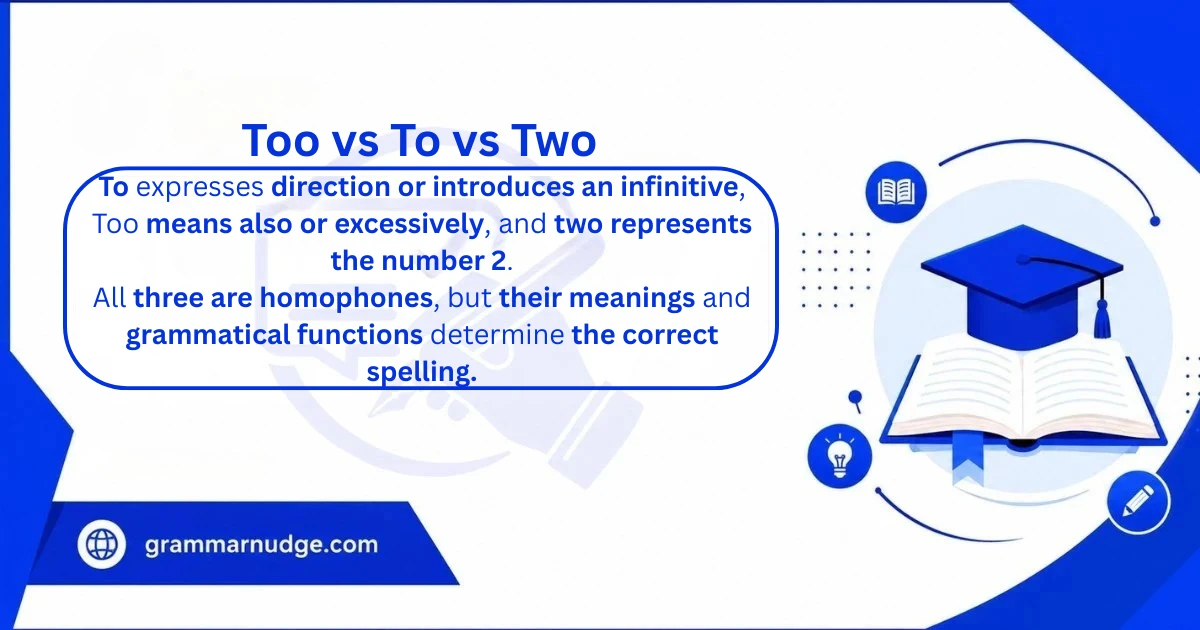
Too vs to vs two comes down to the job each word does. Too means “also” or “excessively,” to shows direction or comes before a verb, and two is the number 2.
All three are homophones, so they sound alike but are spelled differently.
When to Use “To”
To is one of the most common words in English, and it does many jobs. Most mix-ups happen because it looks so much like too.
“To” as a Preposition
As a preposition, to links a word to a place, a person, or a limit.
- Direction: We drove to the lake.
- Recipient: Please give the keys to Maria.
- Range: The store is open from 9 to 5.
- Attachment: The sign is nailed to the fence.
“To” as an Infinitive Marker
To also sits in front of a base verb to make the infinitive: to run, to write, to learn. Example: “She wants to learn Spanish.”
At the end of a sentence, to can stand in for a verb we already said.
More Posts:Into vs On – Meaning, Difference, and Examples
When to Use “Too”
Too is an adverb, and it has two main meanings. Both are easy to spot once you know the swap test.
“Too” Meaning Also or As Well
If you can swap in “also” or “as well,” write too. Example: “I like pizza, too.” Another: “Can I come, too?”
“Too” Meaning Excessively
Here, too means “more than needed.” It often comes before an adjective or adverb.
- Too much goes with things we can’t count: too much sugar.
- Too many goes with things we can count: too many cars.
- Too late means the time has passed. “To late” is almost always wrong.
When to Use “Two”
Two is only the number 2. It never means “also” and never shows direction. If you can write “2” in its place, the spelling is two.
It works as an adjective (two cars), a pronoun (I bought two), and part of a compound adjective (a two-hour drive). It also gives age: “My son is two.”
Too Tired to Drive: When Too and To Share a Sentence
Some sentences need too and to together. The pattern is too + adjective + to + verb. It says something is so extreme that an action becomes difficult or impossible.
- It was too cold to swim.
- She was too tired to drive.
- The offer was too good to refuse.
The negative meaning is built in, so you don’t add “not.” “Too tired to drive” already means she couldn’t drive.
When a noun follows instead of a verb, too pairs with for: “The box is too small for the books.”
More Posts:Could You vs Can You – Meaning, Difference, and Examples
To vs Too vs Two
| Word | Part of Speech | Meaning | Example |
|---|---|---|---|
| To | Preposition / infinitive marker | Direction, receiver, or before a verb | We went to the park to play. |
| Too | Adverb | Also, or more than enough | It was too cold, and I was tired, too. |
| Two | Number / adjective | The number 2 | I ordered two coffees. |
Three tricks make them stick:
- Too: The extra “o” is extra. It means “also” or “excessively.”
- To: Don’t use too many o’s if you only mean to.
- Two: The “w” links it to twin, twice, and twenty, which all relate to the number 2.
A sentence with all three: “It was too late to buy two tickets.”
Final Thoughts
Remember one rule per word. Two is a number, too means “also” or “excessively,” and to covers direction and verbs. Run the quick swap test, and you’ll pick the right word every time.
More Posts:A vs The – Meaning, Difference, and Examples
Too vs To vs Two FAQs
What is the difference between to, too, and two?
To shows direction or comes before a verb. Too means “also” or “excessively.” Two is the number 2.
Is it “too” or “to” at the end of a sentence?
Use too when it means “also,” as in “Me, too.” Use to only when it replaces a verb, as in “I don’t want to.”
How do you remember too vs to vs two?
Think “extra o, extra meaning” for too. Link two with twin and twice. If neither fits, use to.
Is “too” always negative?
No. When too means “also,” it is neutral. When it means “excessively,” it usually points to a problem, like “too loud.”
Is there a spelling difference between American and British English?
No. The rules for to, too, and two are the same in both, so one set of rules covers every reader.

Hi, I’m John Henry, the voice behind Grammar Nudge. I make grammar simple and easy to understand, from basic rules to advanced writing tips. Clear explanations. Practical examples. No confusion.
Related Posts